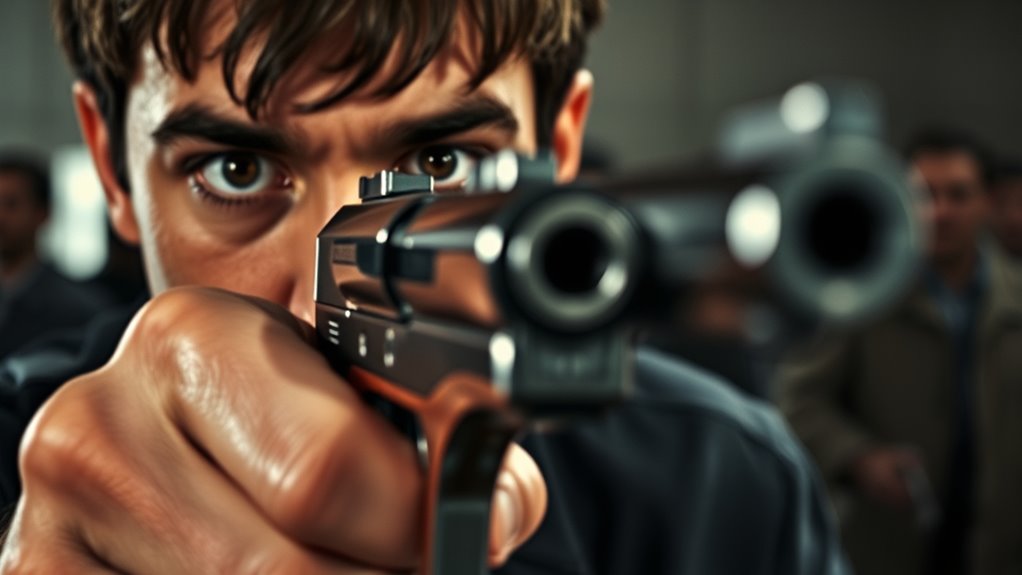

When faced with a threat, your attention naturally zooms in on the weapon, such as a gun or knife, because your survival instinct kicks in. This focus on the weapon narrows your awareness, making it harder to remember other details like the perpetrator’s face or clothing. This effect, known as the weapon focus effect, can cause significant gaps or biases in your memory, which is essential to understand if you want to grasp how perception shifts under stress. To uncover the full picture, keep exploring further.

Turn your wind-down time into listening time
- Thousands of audiobooks, podcasts and originals
- Listen on your phone, tablet or Echo — also offline
- Cancel anytime
Key Takeaways
- The weapon focus effect causes attention to concentrate on the weapon, reducing awareness of other details during a crime.
- Under threat, visual attention narrows, impairing memory for features like faces or clothing.
- High stress and cognitive load increase reliance on focus on the weapon, leading to incomplete eyewitness accounts.
- This effect can bias perceptions, making witnesses more confident but less accurate in identifying perpetrators.
- Recognizing the weapon focus effect is crucial for evaluating the reliability of eyewitness testimony involving weapons.

The weapon focus effect occurs when a witness’s attention becomes concentrated on a weapon during a crime, often impairing their ability to accurately identify the perpetrator. When you witness a criminal holding a gun or knife, your visual attention naturally zeroes in on the threat. This intense focus on the weapon, while understandable, can have unintended consequences for eyewitness accuracy. Instead of taking in the full picture, your attention becomes narrowly directed, making it harder to remember other details like the perpetrator’s face, clothing, or distinguishing features. This phenomenon is a survival instinct—your brain prioritizes the immediate threat—but it can compromise the reliability of eyewitness testimony later on.
As your visual attention narrows onto the weapon, your ability to encode other relevant details diminishes. The brain filters out peripheral information, meaning you might remember the weapon vividly but struggle to recall the face or even the ethnicity of the attacker. This selective attention is a double-edged sword: it helps you react quickly to danger but can lead to significant gaps in memory. Law enforcement officials rely heavily on eyewitness accounts, but the weapon focus effect shows that these accounts can be biased or incomplete when a weapon is involved. This is why, in court, a witness’s confidence might not always correlate with their accuracy—the focus on the weapon distorts what they truly remember.
Your visual attention is a limited resource, and during a high-stress situation like a crime, it becomes even more focused on the most salient threat—often the weapon. Because your brain is wired to prioritize threats for quick response, it naturally allocates more cognitive resources to processing the weapon. This heightened focus can make it difficult to recall details outside of that immediate threat. Even if you try to pay attention to other features, your cognitive load is heavy, and your recall may still be compromised. Recognizing this effect is important for understanding the limitations of eyewitness testimony and why some memories can be unreliable, especially in situations involving weapons. Additionally, the quality of the witness’s attention during the event significantly influences their memory accuracy.
In essence, the weapon focus effect highlights how visual attention shifts under threat, impacting eyewitness accuracy. While your instincts protect you in dangerous moments, they can also distort your memory afterward. Understanding this phenomenon underscores the importance of caution when evaluating eyewitness accounts, especially when a weapon was present. It reminds us that what you remember may be influenced by where your attention was directed during the event, often leading to incomplete or biased recollections.
eyewitness testimony training tools
As an affiliate, we earn on qualifying purchases.
As an affiliate, we earn on qualifying purchases.
Frequently Asked Questions
How Does Weapon Focus Affect Eyewitness Memory Accuracy?
You might notice that weapon focus can reduce your eyewitness memory accuracy by directing your attention solely to the weapon, which often leads to decreased recall of other details. This narrowed focus can cause you to be overconfident in your memory, even if it’s distorted. As a result, your eyewitness confidence may be high, but the actual memory could be flawed, increasing the risk of memory distortion during recall.
Can Training Reduce the Weapon Focus Effect in High-Stress Situations?
Yes, training interventions focusing on stress management can help reduce the weapon focus effect in high-stress situations. When you practice these techniques, you learn to control your attention and stay more aware of relevant details despite threats. This improved focus allows you to better remember critical information, including faces and events, even under pressure. Regular training builds resilience, helping you maintain accuracy when it matters most.
Does Weapon Focus Influence the Ability to Identify Suspects?
You may find that weapon focus can cloud your perception, making it harder to identify suspects accurately. When your cognitive load is high, perception biases kick in, narrowing your attention to the weapon and neglecting other details. It’s like trying to see the forest for the trees. This effect can lead to missed or mistaken identifications, especially under stress, highlighting the importance of managing attention and awareness during critical moments.
Are Certain Types of Weapons More Likely to Cause Focus Effects?
Certain weapon types are more likely to cause focus effects due to their visual salience. For example, guns or shiny objects tend to draw your attention more than less conspicuous weapons like knives. You’ll probably fixate on high-visibility weapons because they stand out and trigger a stronger attentional response. This heightened focus can impair your ability to accurately identify other details, like suspect features, during a threatening situation.
How Long-Lasting Is the Weapon Focus Effect During an Event?
The weapon focus effect can last from seconds to several minutes, depending on the situation. You might notice the duration persistence of this effect because it often causes memory interference, making details outside the weapon less memorable. Research suggests that the more threatening the event, the longer your attention stays fixated, but once the threat diminishes, your focus quickly shifts, reducing the effect’s duration.
crime scene evidence photography kit
As an affiliate, we earn on qualifying purchases.
As an affiliate, we earn on qualifying purchases.
Conclusion
In summary, the weapon focus effect shows how your attention narrows under threat, making you more likely to overlook important details. Notably, studies reveal that witnesses are up to 50% less accurate when a weapon is present during a crime. So, next time you’re in a tense situation, remember how your focus shifts—sometimes to your disadvantage. Staying calm and aware can help you maintain better attention, even when danger feels close.
As an affiliate, we earn on qualifying purchases.
personal safety self-defense kit
As an affiliate, we earn on qualifying purchases.
As an affiliate, we earn on qualifying purchases.
Fall Picks
fall essentials
As an affiliate, we earn on qualifying purchases.