

You might notice that confident witnesses and experts often seem more convincing, but that’s because confidence triggers emotional responses like trust and admiration, making you less critical. Jurors tend to see a confident person as more truthful, even if their statements aren’t accurate. This bias is powerful because it overshadows actual evidence and critical thinking, leading you to mistake assurance for correctness. Keep going to discover more ways confidence influences perception and judgment.
Open a free Amazon Business account
Business pricing, bulk buying and tax-exempt orders.
As an affiliate, we earn on qualifying purchases.
Key Takeaways
- Jurors associate confidence with knowledge, interpreting assuredness as a sign of correctness and truthfulness.
- Confident witnesses and experts project mastery, influencing jurors to accept their statements without scrutiny.
- Emotional reactions like trust and admiration are triggered by confident demeanor, biasing judgment.
- Attorneys can manipulate confidence and emotional cues to persuade jurors and obscure uncertainties.
- Superficial cues such as tone and body language often overshadow actual evidence, leading to misjudgment.
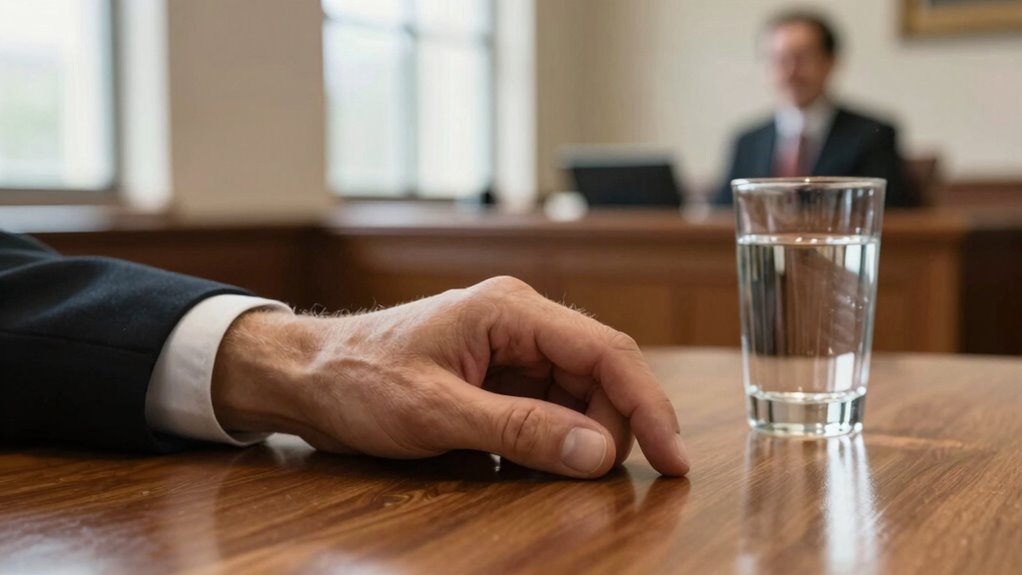
Have you ever wondered why jurors often give more weight to a confident witness than to one who seems less sure? It’s a common phenomenon, and it often comes down to the way confidence influences perception. When a witness speaks with conviction, it’s easy to interpret that confidence as a sign of truthfulness or accuracy. This tendency can be especially strong when jurors are unfamiliar with the intricacies of evidence or the complexities of human memory. Expert testimony can sometimes amplify this effect. When an expert appears confident, jurors are more likely to accept their conclusions without scrutinizing the evidence carefully. This is because confidence signals mastery, and people tend to equate mastery with correctness, even if the expert’s assertions are flawed or incomplete. Additionally, emotional influence plays a significant role in how jurors interpret testimony. When a witness appears confident, they often project certainty, which can evoke emotional responses such as trust or admiration. These emotional reactions may lead jurors to overlook inconsistencies or gaps in the testimony. Instead, they become swayed by the witness’s demeanor and tone, rather than the substance of what’s being said. This emotional influence can be particularly potent when the case involves emotionally charged topics or personal stories, making it even harder to objectively evaluate the credibility of the testimony. As a juror, you might find yourself subconsciously trusting a confident witness more than a hesitant one, even when the evidence suggests otherwise. This bias can be exploited, especially by attorneys who know how to craft their witnesses’ delivery to maximize confidence. When expert witnesses deliver their opinions with authority, it’s tempting to accept their statements at face value, sometimes ignoring critical details or alternative explanations. The truth is, confidence is a powerful tool that can mask uncertainty, and emotional influence can amplify that effect. Recognizing this tendency is the first step toward a more balanced evaluation of testimony. Being aware that confidence can be mistaken for accuracy is crucial, especially considering how perception is shaped by emotional cues and superficial cues rather than the actual evidence. It’s important to understand how cognitive biases can influence judgment and decision-making in a courtroom setting. For example, confirmation bias can lead jurors to focus only on information that supports their initial impressions, further skewing their perception of credibility. Ultimately, understanding that confidence and emotional influence are not reliable markers of truth helps you approach testimonies more critically. Whether it’s an expert’s opinion or a lay witness’s account, it’s essential to look beyond the surface and focus on the evidence and reasoning behind what’s being presented. Confidence can be persuasive, but it doesn’t guarantee accuracy—something you should keep in mind as you weigh the facts.
video recording device for courtroom observation
As an affiliate, we earn on qualifying purchases.
As an affiliate, we earn on qualifying purchases.
Frequently Asked Questions
How Does Emotional Bias Influence Jurors’ Perceptions?
Emotional bias influences your perceptions by causing you to rely heavily on emotional cues rather than facts. When emotional cues evoke strong feelings, you might interpret evidence through personal biases, giving undue weight to emotional reactions. This can lead you to believe a witness or argument is more credible simply because it stirs your emotions, rather than evaluating the evidence objectively. Your personal biases shape how emotional cues impact your judgment.
What Role Does Cognitive Bias Play in Jury Decision-Making?
Cognitive bias influences your jury decision-making by causing prejudicial stereotypes and memory distortions. You might overestimate a witness’s credibility based on superficial traits, misjudge evidence, or recall details inaccurately. These biases lead you to favor confidence over actual accuracy, making you more likely to trust a persuasive but incorrect story. Recognizing these biases helps you critically evaluate evidence, preventing prejudiced assumptions from unfairly swaying your verdict.
Can Confidence Levels Be Objectively Measured During Trials?
Confidence levels can’t be objectively measured during trials, but you can observe juror perception and confidence calibration. You might notice how certain jurors express certainty or hesitation, yet these signals don’t definitively reflect truth or accuracy. While verbal and non-verbal cues suggest confidence, they’re subjective indicators, not quantifiable metrics. Consequently, evaluating actual confidence involves understanding perceptions, but true calibration remains elusive without standardized, scientific measures.
How Does Expert Testimony Impact Jurors’ Confidence?
Expert testimony substantially boosts your confidence in a case, especially when the expert has strong credibility and presents clear, understandable testimony. You tend to trust confident experts more, assuming their certainty reflects truth. However, this confidence can be misleading if the expert’s credibility is overstated or their testimony is overly complex. As a juror, you should critically evaluate both the credibility and clarity of expert testimony rather than equate confidence with accuracy.
Are There Legal Strategies to Reduce Confidence-Based Errors?
You can implement legal strategies like enhanced jury education and confidence calibration to reduce confidence-based errors. Picture a jury carefully weighing evidence, not just swayed by certainty but by understanding its reliability. By emphasizing these techniques, you help jurors recognize overconfidence, encouraging them to scrutinize their judgments more critically. This approach fosters balanced decision-making, ensuring verdicts are rooted in true accuracy rather than misplaced confidence, ultimately strengthening the justice process.
As an affiliate, we earn on qualifying purchases.
Conclusion
So, next time you sit in a courtroom, remember this: that confident witness might just be the most mistaken person in the room. Your gut might scream “truth,” but don’t let their soaring confidence fool you into accepting their word as fact. Confidence can be a mirage, an illusion so convincing it blinds you to the truth. Stay sharp, question everything, and don’t let a confident voice drown out the real evidence.
public speaking confidence training course
As an affiliate, we earn on qualifying purchases.
As an affiliate, we earn on qualifying purchases.
emotional intelligence assessment tools
As an affiliate, we earn on qualifying purchases.
As an affiliate, we earn on qualifying purchases.
NFL season / tailgating Picks
team gear
As an affiliate, we earn on qualifying purchases.