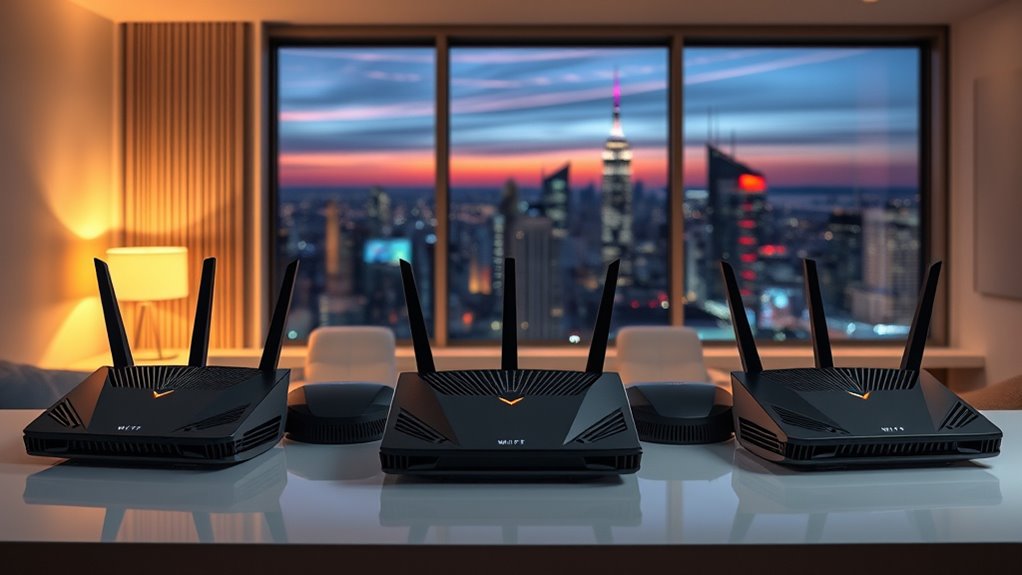

As wifi 7 routers start to hit the market, many buyers face the challenge of choosing the right one amidst a growing array of options. The best overall pick is the TP-Link Archer BE550 Pro, offering a balanced mix of speed, coverage, and features. For those prioritizing mesh coverage, the Deco 7 Pro stands out with its impressive whole-home performance. Gamers and power users should note the ASUS ROG Strix GS-BE12000 for its high speeds and low latency. However, tradeoffs between price, complexity, and coverage mean understanding your specific needs is key. Continue reading to see how these models compare so you can make an informed decision.

Turn your wind-down time into listening time
- Thousands of audiobooks, podcasts and originals
- Listen on your phone, tablet or Echo — also offline
- Cancel anytime
Key Takeaways
- Top-tier wifi 7 routers combine multi-gigabit speeds with extensive coverage, but often come with higher prices.
- Mesh systems excel for large homes, though they may sacrifice some direct device control compared to traditional routers.
- Gaming-focused routers prioritize low latency and advanced QoS features, often at the expense of higher cost and complexity.
- Budget-friendly options are available but may lack the full range of wifi 7 features or optimal coverage for larger spaces.
- Choosing the right wifi 7 router depends heavily on your home size, device load, and specific use cases like gaming or streaming.
| TP-Link BE6500 Dual-Band WiFi 7 Router (BE400) |  | Best Overall for Large Homes with High-Speed Needs | Technology: Wi-Fi 7 | Bands: Dual-Band | Max Speed: up to 5764 Mbps on 5GHz and 688 Mbps on 2.4GHz | VIEW ON AMAZON | See Our Full Breakdown |
| Deco 7 Dual-Band WiFi 7 Mesh System with 4 Streams and 5 Gbps Speed |  | Best for Large-Scale Coverage and Seamless Roaming | Wi-Fi Standard: WiFi 7 | Speed: 5 Gbps | Coverage: Up to 6,600 sq. ft. | VIEW ON AMAZON | See Our Full Breakdown |
| TP-Link Tri-Band WiFi 7 Router, Archer BE550 Pro |  | Best for Power Users Needing Extensive Wired Options | WiFi Bands: Tri-band | Speed: Up to 320 MHz channels on 6 GHz | Ports: One 10 Gbps WAN, four 2.5 Gbps LAN, USB 3.0 | VIEW ON AMAZON | See Our Full Breakdown |
| Deco 7 Pro Tri-Band WiFi 7 BE10000 Whole Home Mesh System 6-Stream 10 Gbps |  | Best for Ultimate Coverage and Speed in Large Homes | Coverage: 7,600 sq. ft. | Wi-Fi Bands: Tri-band WiFi 7 | Speed: Up to 10 Gbps | VIEW ON AMAZON | See Our Full Breakdown |
| TP-Link Tri-Band WiFi 7 Router (Archer BE550) |  | Best for Versatile High-Speed Home Networking | WiFi Bands: Tri-band | Max Speed: 5760 Mbps | Ports: 1x 2.5G WAN, 4x 2.5G LAN, USB 3.0 | VIEW ON AMAZON | See Our Full Breakdown |
| TP-Link Tri-Band WiFi 7 Router (Archer BE600) |  | Best Overall | WiFi Technology: WiFi 7 | Speed: up to 5,765 Mbps | Coverage: up to 2,600 sq. ft. | VIEW ON AMAZON | See Our Full Breakdown |
| GL.iNet GL-BE9300 Flint 3 Tri-Band Wi-Fi 7 Router |  | Best for Gaming and Large Device Networks | Wi-Fi Standard: Wi-Fi 7 | Speed: up to 9 Gbps | Number of Bands: Tri-band | VIEW ON AMAZON | See Our Full Breakdown |
| NETGEAR Nighthawk WiFi 7 Router RS140 |  | Best for Large Homes with Moderate Speed Needs | Coverage: 2,250 sq ft | Speed: up to 5 Gbps | WiFi Bands: Dual-band | VIEW ON AMAZON | See Our Full Breakdown |
| eero 7 Dual-Band Mesh Wi-Fi 7 Router (2-Pack) |  | Best for Smart Homes and Seamless Coverage | Connectivity: Dual-band Wi-Fi 7 | Coverage: 4,000 sq. ft. | Internet Speed Support: up to 2.5 Gbps | VIEW ON AMAZON | See Our Full Breakdown |
| TP-Link Dual-Band Wi-Fi 7 Router, Archer BE3600 |  | Best for Easy Setup and Smart Home Integration | Wi-Fi Technology: Wi-Fi 7 | Speed (5 GHz): 2882 Mbps | Speed (2.4 GHz): 688 Mbps | VIEW ON AMAZON | See Our Full Breakdown |
| TP-Link Deco 7 Pro BE63 Tri-Band WiFi 7 Whole Home Mesh System |  | Best Overall for Extensive Coverage and Device Support | Coverage: 5,800 sq.ft. | Wi-Fi Standard: Wi-Fi 7 | Speed: up to 10,188 Mbps | VIEW ON AMAZON | See Our Full Breakdown |
| NETGEAR Nighthawk WiFi 7 Router RS90, Up to 2,000 sq ft, 3.6 Gbps |  | Best for Fast, Reliable Coverage of Medium-Sized Homes | Speed: 3.6 Gbps | Coverage: 2,000 sq ft | Bands: Dual-band | VIEW ON AMAZON | See Our Full Breakdown |
| ASUS ROG Strix GS-BE12000 WiFi 7 Gaming Router – Tri-Band, 12Gbps, Mesh |  | Best for High-Performance Gaming and Heavy Data Use | WiFi Standard: WiFi 7 | Tri-Band: Yes | Max Throughput: 12 Gbps | VIEW ON AMAZON | See Our Full Breakdown |
| ASUS RT-BE82U WiFi 7 Router – Dual-Band, 6.5 Gbps, Mesh + VPN Compatible |  | Best for High-Speed Home or Small Business Networks with Mesh and Security | WiFi Standard: WiFi 7 | Speed: 6.5 Gbps | Bands: Dual-band | VIEW ON AMAZON | See Our Full Breakdown |
| wifi 7 router | Coverage | Speed | Ports | Security |
|---|---|---|---|---|
| TP-Link BE6500 Dual-Band WiFi | Up to 2,400 sq. ft. | — | 1x 2.5 Gbps WAN/LAN, 1x 2.5 Gbps LAN, 3x 1 Gbps LAN | WPA3 encryption, HomeShield |
| Deco 7 Dual-Band WiFi 7 Mesh S | Up to 6,600 sq. ft. | 5 Gbps | — | TP-Link HomeShield |
| TP-Link Tri-Band WiFi 7 Router | — | Up to 320 MHz channels on 6 GHz | One 10 Gbps WAN, four 2.5 Gbps LAN, USB 3.0 | HomeShield with parental controls |
| Deco 7 Pro Tri-Band WiFi 7 BE1 | 7,600 sq. ft. | Up to 10 Gbps | Four 2.5G WAN/LAN, USB 3.0 | — |
| TP-Link Tri-Band WiFi 7 Router | — | — | 1x 2.5G WAN, 4x 2.5G LAN, USB 3.0 | WPA3, HomeShield |
| TP-Link Tri-Band WiFi 7 Router | up to 2,600 sq. ft. | up to 5,765 Mbps | 1x 10 Gbps WAN/LAN, 1x 2.5 Gbps WAN/LAN, 3x 2.5 Gbps LAN | HomeShield security suite |
| GL.iNet GL-BE9300 Flint 3 Tri- | up to 2,000 sq ft | up to 9 Gbps | — | — |
| NETGEAR Nighthawk WiFi 7 Route | 2,250 sq ft | up to 5 Gbps | — | NETGEAR Armor (trial) |
| eero 7 Dual-Band Mesh Wi-Fi 7 | 4,000 sq. ft. | — | — | — |
| TP-Link Dual-Band Wi-Fi 7 Rout | Up to 2,000 sq. ft. | — | 1 x 2.5 Gbps WAN/LAN, 1 x 2.5 Gbps LAN, 3 x 1 Gbps LAN | TP-Link HomeShield with parental controls |
| TP-Link Deco 7 Pro BE63 Tri-Ba | 5,800 sq.ft. | up to 10,188 Mbps | Four 2.5G WAN/LAN, USB 3.0 | — |
| NETGEAR Nighthawk WiFi 7 Route | 2,000 sq ft | 3.6 Gbps | One 2.5G WAN, Four 1G Ethernet LAN | — |
| ASUS ROG Strix GS-BE12000 WiFi | — | — | — | — |
| ASUS RT-BE82U WiFi 7 Router | — | 6.5 Gbps | — | AiProtection Pro + VPN |
More Details on Our Top Picks
TP-Link BE6500 Dual-Band WiFi 7 Router (BE400)
The TP-Link BE6500 stands out for its impressive combination of high throughput and broad coverage, making it ideal for large households with multiple demanding devices. Its dual-band setup supports speeds up to 5764 Mbps on 5 GHz, outperforming many WiFi 6 options in speed and reliability. Compared to the Deco 7 Mesh System, it offers a more straightforward setup for those who prefer a single-router solution rather than a mesh system, though it doesn’t support mesh extensions itself. Its 6 high-performance antennas and advanced features like MU-MIMO and OFDMA translate into fewer dead zones and smoother streaming or gaming. However, it isn’t compatible with mesh systems like Deco, which could limit expansion options, and it requires a separate modem. Overall, this router makes the most sense for large homes needing robust, fast Wi-Fi without the complexity of mesh setups, provided users are comfortable managing a non-mesh environment.
Pros:- Supports the latest Wi-Fi 7 technology for ultra-fast speeds
- Wide coverage up to 2,400 sq. ft. suitable for large homes
- Easy setup via the Tether app with security features like WPA3
Cons:- Not compatible with mesh WiFi systems like Deco
- Requires a separate modem for internet connection
Best for: Large households or those with multiple high-bandwidth devices seeking a reliable, high-speed router
Not ideal for: Users wanting a seamless mesh system or looking for an all-in-one solution; those with limited technical knowledge may find advanced features challenging
- Technology:Wi-Fi 7
- Bands:Dual-Band
- Max Speed:up to 5764 Mbps on 5GHz and 688 Mbps on 2.4GHz
- Coverage:Up to 2,400 sq. ft.
- Ports:1x 2.5 Gbps WAN/LAN, 1x 2.5 Gbps LAN, 3x 1 Gbps LAN
- Antennas:6 high-performance antennas
- Security:WPA3 encryption, HomeShield
- Compatibility:Alexa, Google Assistant
Our verdict“This router is a strong choice for large homes that prioritize speed and coverage over mesh expandability.”
Deco 7 Dual-Band WiFi 7 Mesh System with 4 Streams and 5 Gbps Speed
The Deco 7 Mesh System excels in delivering extensive coverage, with up to 6,600 sq. ft., making it ideal for sprawling homes or properties with multiple floors. Its dual-band WiFi 7 provides speeds up to 4324 Mbps, and the 4 streams ensure reliable, high-speed connections across numerous devices. Unlike the TP-Link BE6500, which is a single-router setup, the Deco 7’s mesh architecture offers seamless roaming, eliminating dead zones as users move around the house. Setup via the Deco app is straightforward, catering to less tech-savvy users, although the system’s performance depends heavily on the number of nodes, and adding more units can become costly. Modem compatibility isn’t built-in, so users must have their own. This system makes the most sense for large homes needing flexible, whole-home coverage with easy management, but it’s less suited for smaller spaces or those who prefer a simple, single-router solution.
Pros:- Extensive coverage up to 6,600 sq. ft. for large homes
- High-speed Wi-Fi 7 with 4 streams for reliable device connections
- Seamless AI-driven roaming ensures stable coverage as users move around
Cons:- Requires at least two units for optimal performance, increasing cost
- Modem not included, requiring an additional purchase
Best for: Homeowners with large properties seeking dependable whole-home Wi-Fi with easy expansion
Not ideal for: Small apartments or users who prefer a single, straightforward router without mesh complexity
- Wi-Fi Standard:WiFi 7
- Speed:5 Gbps
- Coverage:Up to 6,600 sq. ft.
- Number of Streams:4
- Ethernet:2.5G Ethernet
- Security:TP-Link HomeShield
Our verdict“Ideal for large homes needing flexible, scalable Wi-Fi coverage with reliable performance across many devices.”
TP-Link Tri-Band WiFi 7 Router, Archer BE550 Pro
The Archer BE550 Pro is distinguished by its tri-band setup and cutting-edge channels on the 6 GHz band, offering speeds up to 320 MHz. Compared to the dual-band BE6500, it provides more bandwidth and better performance in congested environments. The four gigabit LAN ports and 10 Gbps WAN port cater to users with multiple wired devices or home offices that demand fast, stable connections. The setup via the Tether app is straightforward, but the router’s higher price and complex features might be overwhelming for casual users or those with simple needs. It requires a modem, like most high-end routers, but its advanced channels make it more future-proof for tech enthusiasts with demanding networking needs. This makes sense for power users who want maximum wired and wireless performance, but less so for average households with minimal wired connections.
Pros:- High-performance tri-band WiFi 7 with 6 GHz channels
- Multiple gigabit ports and 10 Gbps WAN for extensive wired connectivity
- Easy setup with mobile app and advanced security features
Cons:- Requires a modem for most internet providers, adding to setup complexity
- Higher cost compared to standard WiFi 6 routers
Best for: Tech-savvy users with multiple wired devices or high-performance home offices
Not ideal for: Casual users or small households seeking a simple, affordable Wi-Fi solution
- WiFi Bands:Tri-band
- Speed:Up to 320 MHz channels on 6 GHz
- Ports:One 10 Gbps WAN, four 2.5 Gbps LAN, USB 3.0
- Antennas:6 antennas with Beamforming
- Compatibility:WiFi 4/5/6/7, compatible with any ISP
- Security:HomeShield with parental controls
Our verdict“Best suited for users demanding maximum wired and wireless speeds, especially in busy, tech-driven environments.”
Deco 7 Pro Tri-Band WiFi 7 BE10000 Whole Home Mesh System 6-Stream 10 Gbps
The Deco 7 Pro BE10000 delivers unparalleled coverage, supporting over 200 devices across up to 7,600 sq. ft. of home space. Its tri-band Wi-Fi 7 setup provides speeds up to 10 Gbps, far exceeding typical single-router setups like the Archer BE550. The system’s multi-gig Ethernet ports and AI-Roaming technology ensure seamless, fast connections, even with many concurrent users. Its easy setup via the Deco app appeals to non-technical users, but the high cost and need for multiple units may deter those with smaller spaces or tighter budgets. The system’s advanced security features and compatibility with all Wi-Fi generations make it an excellent choice for sprawling properties with demanding networking needs. Performance can vary depending on environment and device placement, but overall, this system prioritizes coverage and speed for large-scale, device-dense homes.
Pros:- Supports over 200 devices with extensive coverage up to 7,600 sq. ft.
- Ultra-fast speeds up to 10 Gbps across multiple bands
- Easy setup, AI-driven mesh with seamless roaming
Cons:- Requires a separate modem for internet access
- High price point and complexity for smaller homes
Best for: Large households or multi-device environments requiring extensive, reliable coverage
Not ideal for: Small apartments or users seeking a simple, budget-friendly Wi-Fi solution
- Coverage:7,600 sq. ft.
- Wi-Fi Bands:Tri-band WiFi 7
- Speed:Up to 10 Gbps
- Number of Devices:Over 200
- Ports:Four 2.5G WAN/LAN, USB 3.0
- Technology:AI-Roaming, Mesh WiFi, HomeShield security
Our verdict“Perfect for large, device-rich homes needing maximum coverage and speed with easy management.”
TP-Link Tri-Band WiFi 7 Router (Archer BE550)
The Archer BE550 offers a balanced combination of tri-band Wi-Fi 7 performance, reaching speeds up to 5760 Mbps, suitable for demanding streaming and gaming setups. Its support for EasyMesh allows for flexible expansion and seamless coverage across larger homes, a feature not present in the BE6500. The four 2.5G LAN ports and 6 antennas with Beamforming enhance wired and wireless reliability, making it a versatile option for tech enthusiasts. Its straightforward setup with the Tether app simplifies initial configuration, but the high price and complex features may be unnecessary for casual users. It requires a modem, like most high-end routers, and is best suited for users who want robust performance with room to grow. Overall, it strikes a good balance for those who need both speed and expandability, despite its advanced feature set potentially overwhelming less technical users.
Pros:- High-speed tri-band WiFi 7 with up to 5760 Mbps
- Supports EasyMesh for flexible coverage expansion
- Multiple gigabit ports and Beamforming for reliable connections
Cons:- Requires a modem for most providers, adding complexity
- Higher price compared to simpler WiFi 6 routers
Best for: Home users needing high-speed Wi-Fi and future-proof wired options with easy setup
Not ideal for: Casual users or those with small spaces who do not need extensive wired or mesh options
- WiFi Bands:Tri-band
- Max Speed:5760 Mbps
- Ports:1x 2.5G WAN, 4x 2.5G LAN, USB 3.0
- Antennas:6 antennas with Beamforming
- Compatibility:Supports WiFi 4/5/6/7, works with any ISP
- Security:WPA3, HomeShield
Our verdict“This router suits users wanting high-speed, expandable Wi-Fi with reliable wired connectivity and easy setup.”
TP-Link Tri-Band WiFi 7 Router (Archer BE600)
The TP-Link Archer BE600 stands out for combining ultra-fast WiFi 7 speeds with expansive coverage, making it an ideal choice for large households with multiple high-bandwidth devices. Its tri-band design and multi-gig ports outperform dual-band options like the NETGEAR Nighthawk RS140 in handling dense networks and demanding streaming or gaming sessions. While setup is straightforward via the Tether app, the process can be daunting for non-technical users, and the premium price reflects its advanced features. This router is best suited for tech-savvy homeowners who need robust coverage and fast wired connectivity, but those with simpler needs or limited budgets might find it overkill.
Pros:- Supports WiFi 7 speeds up to 5,765 Mbps for seamless high-bandwidth activities
- Extensive coverage of up to 2,600 sq. ft. suitable for large homes
- Multiple multi-gig ports enable fast wired connections
- Advanced security with HomeShield suite
Cons:- Complex setup process for users unfamiliar with network configuration
- High price point may be prohibitive for budget-conscious buyers
Best for: Large families with multiple streaming, gaming, and smart home devices needing reliable high-speed WiFi.
Not ideal for: Casual users or small apartments where simpler, less expensive routers suffice, due to its complexity and cost.
- WiFi Technology:WiFi 7
- Speed:up to 5,765 Mbps
- Coverage:up to 2,600 sq. ft.
- Antennas:6
- Ports:1x 10 Gbps WAN/LAN, 1x 2.5 Gbps WAN/LAN, 3x 2.5 Gbps LAN
- Security:HomeShield security suite
Our verdict“This router is ideal for power users in large homes who demand maximum speed and coverage but are comfortable with advanced setup.”
GL.iNet GL-BE9300 Flint 3 Tri-Band Wi-Fi 7 Router
The GL.iNet GL-BE9300 Flint 3 offers impressive speeds up to 9 Gbps, which surpasses many competitors like the NETGEAR RS140, especially in environments with numerous devices. Its tri-band configuration ensures stable connections for gaming, streaming, and smart home devices, thanks to advanced features like MLO and OFDMA. However, setup might require firmware updates, and its complex feature set may challenge average users unfamiliar with networking technology. This model makes the most sense for gamers or large networks needing ultra-reliable performance, but less so for users seeking simple plug-and-play solutions.
Pros:- Supports Wi-Fi 7 speeds up to 9 Gbps for demanding applications
- Handles over 100 devices simultaneously with stable connectivity
- Includes advanced features like MLO, OFDMA, and parental controls
- Extensive coverage up to 2,000 sq. ft.
Cons:- Setup may require firmware updates or technical knowledge
- Complex feature set could be confusing for average users
Best for: Gamers and tech enthusiasts managing extensive smart home networks with high-speed demands.
Not ideal for: Casual users or those prioritizing simplicity over advanced customization, as setup and features can be overwhelming.
- Wi-Fi Standard:Wi-Fi 7
- Speed:up to 9 Gbps
- Number of Bands:Tri-band
- Ethernet Ports:5 x 2.5G
- Coverage:up to 2,000 sq ft
- Device Capacity:Over 100 devices
Our verdict“Designed for power users needing maximum speed and device capacity, especially gamers and large smart homes, but less suitable for novices.”
NETGEAR Nighthawk WiFi 7 Router RS140
The NETGEAR Nighthawk RS140 provides dependable WiFi coverage up to 2,250 sq. ft. with speeds reaching 5 Gbps, making it a solid choice for large households that don’t require the absolute highest speeds. Compared to the TP-Link BE600, it offers easier management via the Nighthawk app and straightforward setup, but its dual-band configuration limits performance in extremely dense environments. Its security features, including a trial of NETGEAR Armor, add value, although a subscription is required for full security. This router suits users who want reliable WiFi without the complications of advanced features or multi-gig ports.
Pros:- Fast WiFi speeds up to 5 Gbps for smooth streaming and gaming
- Wide coverage of up to 2,250 sq. ft.
- Easy setup and management via the Nighthawk app
- Supports multiple devices simultaneously
Cons:- Limited to dual-band WiFi, restricting performance in crowded networks
- Requires subscription for complete security features after trial
Best for: Large homes with multiple devices seeking simple, reliable WiFi coverage at moderate speeds.
Not ideal for: Power users needing ultra-fast speeds or extensive wired connectivity, as it lacks multi-gig ports and the coverage could fall short in sprawling homes.
- Coverage:2,250 sq ft
- Speed:up to 5 Gbps
- WiFi Bands:Dual-band
- Max Devices:80
- WAN Port:2.5 Gig
- Ethernet Ports:3 x 1 Gig
- Security:NETGEAR Armor (trial)
Our verdict“Ideal for large households wanting straightforward WiFi coverage with decent speed but not for users requiring the latest multi-gig wired ports.”
eero 7 Dual-Band Mesh Wi-Fi 7 Router (2-Pack)
The eero 7 2-pack offers a cost-effective way to blanket large areas up to 4,000 sq. ft. with reliable WiFi 7, supporting over 120 devices. Its dual-band setup may not match the raw speed of tri-band models like the GL.iNet Flint 3, but it excels in minimizing dead spots and maintaining consistent connectivity across a smart home environment. The system’s backward compatibility and straightforward setup make it accessible for non-technical users, although a subscription is required for enhanced security features. This mesh system is best suited for households prioritizing extensive coverage and device support over maximum raw speed, but it may fall short where ultra-high-speed connections are needed.
Pros:- Supports Wi-Fi 7 speeds supporting up to 2.5 Gbps plans
- Coverage of up to 4,000 sq. ft. with two units
- Supports over 120 devices simultaneously
- Backward compatibility with previous eero systems
Cons:- Requires subscription for advanced security features
- Dual-band setup offers lower peak speeds compared to tri-band alternatives
Best for: Smart home enthusiasts needing broad coverage and reliable device support without complex configuration.
Not ideal for: Users needing the fastest possible speeds or a simple single-router setup, as mesh systems typically introduce latency and complexity.
- Connectivity:Dual-band Wi-Fi 7
- Coverage:4,000 sq. ft.
- Internet Speed Support:up to 2.5 Gbps
- Device Support:120+ devices
- Number of Units:2-pack
- Compatibility:Backward compatible with previous eero models
Our verdict“Perfect for large smart homes seeking extensive and reliable WiFi coverage with easy management, but not for those requiring the highest speeds or simple single-router solutions.”
TP-Link Dual-Band Wi-Fi 7 Router, Archer BE3600
The TP-Link Archer BE3600 offers solid dual-band WiFi 7 performance with speeds up to 2,882 Mbps on 5 GHz, making it suitable for streaming, gaming, and smart home devices. Compared to the GL.iNet Flint 3, it provides a more straightforward setup via the Tether app and better compatibility with popular smart home platforms like Alexa and Google Assistant. Its beamforming and multiple ports support extensive coverage and device connections. However, it does not support the 6 GHz band, limiting future-proofing and peak performance potential. This router makes sense for users who want a reliable, easy-to-manage WiFi 7 network without the complexity of advanced features or multi-gig wired ports.
Pros:- Supports WiFi 7 speeds up to 2,882 Mbps for high-quality streaming and gaming
- Easy setup via Tether app for non-technical users
- Good coverage with beamforming and multiple ports
- Compatible with Alexa and Google Assistant
Cons:- Lacks support for 6 GHz band, limiting future speed upgrades
- Performance varies based on environment and obstacles
Best for: Home users seeking a balance of high-speed WiFi and smart home compatibility with minimal setup fuss.
Not ideal for: Power users or gamers needing ultra-fast speeds or multi-gig wired ports, as it lacks support for 6 GHz and higher performance features.
- Wi-Fi Technology:Wi-Fi 7
- Speed (5 GHz):2882 Mbps
- Speed (2.4 GHz):688 Mbps
- Ports:1 x 2.5 Gbps WAN/LAN, 1 x 2.5 Gbps LAN, 3 x 1 Gbps LAN
- Coverage:Up to 2,000 sq. ft.
- Security:TP-Link HomeShield with parental controls
Our verdict“Ideal for typical home users wanting reliable WiFi 7 with easy setup and smart home compatibility, but less suited for high-end gaming or ultra-fast needs.”
TP-Link Deco 7 Pro BE63 Tri-Band WiFi 7 Whole Home Mesh System
The TP-Link Deco 7 Pro BE63 stands out for its expansive coverage of up to 5,800 sq.ft., making it ideal for large homes. Compared with the ASUS RT-BE82U, which offers similar high speeds but is more suited for smaller spaces, the Deco 7 Pro prioritizes broad reach over ultra-high throughput. Its support for over 200 devices and multiple wired ports provides flexibility for busy smart homes. However, it relies on a separate modem, adding complexity, and its higher price reflects its extensive features. Performance may vary based on environment and obstacles, but its robust security via TP-Link HomeShield enhances network safety. This mesh system is best for homeowners needing comprehensive coverage and device support without sacrificing speed for multiple users.
Pros:- Extensive coverage up to 5,800 sq.ft. accommodating large homes
- Supports over 200 devices simultaneously, ideal for smart homes
- Includes four 2.5G LAN/WAN ports and USB 3.0 for wired flexibility
- Easy setup and management via the Deco app
Cons:- Requires a separate modem, adding setup complexity
- Performance can fluctuate based on environmental factors
- Higher price point due to advanced mesh features
Best for: Large households with many smart devices and demanding streaming or gaming needs
Not ideal for: Small apartments or users seeking ultra-high gaming speeds—it’s optimized for coverage, not raw throughput
- Coverage:5,800 sq.ft.
- Wi-Fi Standard:Wi-Fi 7
- Speed:up to 10,188 Mbps
- Bands:Tri-band (6 GHz, 5 GHz, 2.4 GHz)
- Ports:Four 2.5G WAN/LAN, USB 3.0
- Device Support:Over 200 devices
Our verdict“Best suited for large homes requiring broad coverage and device capacity, despite a higher price and setup considerations.”
NETGEAR Nighthawk WiFi 7 Router RS90, Up to 2,000 sq ft, 3.6 Gbps
The NETGEAR Nighthawk RS90 offers reliable WiFi 7 speeds up to 3.6 Gbps within a 2,000 sq.ft. range, making it suitable for most standard-sized homes. It compares favorably to the ASUS RT-BE82U in terms of setup simplicity and security features like NETGEAR Armor, but its dual-band design may limit peak throughput for heavy multi-user environments. While it supports gigabit internet and multiple devices, real-world speeds depend heavily on device compatibility and subscription plans. Its coverage is adequate for many homes, but larger or multi-story residences might require additional mesh units. The security trial is beneficial but requires subscription renewal for continued protection. This router makes sense for users seeking a balance of speed, ease of use, and security in medium-sized homes.
Pros:- Fast speeds up to 3.6 Gbps suitable for streaming and gaming
- Coverage of up to 2,000 sq.ft. fits most homes
- Simple setup and management via the Nighthawk app
- Supports multi-gig internet connections
Cons:- Speeds depend on device compatibility and internet plan
- May require additional units for larger homes
- Security trial requires ongoing subscription
Best for: Families or small offices needing reliable, fast WiFi in a medium-sized space
Not ideal for: Very large homes or high-end gaming setups requiring ultra-high throughput and mesh coverage
- Speed:3.6 Gbps
- Coverage:2,000 sq ft
- Bands:Dual-band
- WiFi Standard:WiFi 7
- Ports:One 2.5G WAN, Four 1G Ethernet LAN
- Compatibility:Works with most providers
Our verdict“A solid choice for medium-sized homes needing reliable WiFi with decent speed and security features, though not ideal for very large spaces.”
ASUS ROG Strix GS-BE12000 WiFi 7 Gaming Router – Tri-Band, 12Gbps, Mesh
The ASUS ROG Strix GS-BE12000 supports WiFi 7 with a maximum throughput of 12 Gbps, designed specifically for gaming, streaming, and intense data transfer. Its extensive coverage of 3,000 sq.ft. and multiple high-speed Ethernet ports make it ideal for multi-device setups with demanding bandwidth needs. Compared with the TP-Link Deco 7 Pro, which excels in mesh coverage, this router prioritizes raw speed and wired connectivity, but its setup can be complex for less tech-savvy users. The high price reflects its gaming-centric features and powerful hardware, including a quad-core CPU and 8 internal antennas. Setup complexity and cost are tradeoffs for enthusiasts needing ultra-fast, wired, and wireless speeds for gaming or professional workloads. It’s best for hardcore gamers or heavy streamers requiring maximum throughput.
Pros:- Supports WiFi 7 with peak throughput of 12 Gbps
- Extensive coverage with 8 internal antennas and multiple Ethernet ports
- Powerful quad-core CPU handles high data loads
- Advanced security features for gaming and smart home protection
Cons:- Complex setup process for non-technical users
- Premium price may be prohibitive for casual users
- Overkill for small, less demanding spaces
Best for: Gamers and power users demanding top-tier speeds and extensive wired options
Not ideal for: Casual users or those with small homes, as the setup and cost may be overkill
- WiFi Standard:WiFi 7
- Tri-Band:Yes
- Max Throughput:12 Gbps
- Range:3,000 sq. ft.
- WAN Ports:1 x 2.5G
- LAN Ports:7 x 2.5G
Our verdict“Best suited for gamers and tech enthusiasts needing maximum speed and wired flexibility, despite its complexity and cost.”
ASUS RT-BE82U WiFi 7 Router – Dual-Band, 6.5 Gbps, Mesh + VPN Compatible
The ASUS RT-BE82U offers dual-band WiFi 7 connectivity with speeds up to 6.5 Gbps, combined with AiMesh support for seamless coverage. It compares favorably to the NETGEAR RS90 in speed and mesh extendability, making it a good choice for users who want a high-performance, flexible network. Its five 2.5GbE ports support high-speed wired connections, and the integrated VPN compatibility adds a layer of security for remote work. Setup can be challenging for beginners, and the higher price may deter users with simpler needs. Its dual-band design slightly limits peak throughput compared to tri-band options, but it strikes a good balance for high-speed, secure networks in homes or small offices.
Pros:- Fast speeds up to 6.5 Gbps suitable for demanding tasks
- Mesh extendability for whole-home coverage
- Multiple 2.5GbE ports for high-performance wired connections
- Supports VPN and advanced security features
Cons:- Setup may be complex for less experienced users
- Higher cost for a dual-band router with advanced features
- Limited peak throughput compared to tri-band routers
Best for: Small businesses or tech-savvy home users needing fast, secure WiFi with mesh capabilities
Not ideal for: Large homes or users seeking maximum bandwidth for gaming, as dual-band limits peak speeds compared to tri-band models
- WiFi Standard:WiFi 7
- Speed:6.5 Gbps
- Bands:Dual-band
- Ethernet Ports:5 x 2.5GbE
- Mesh Compatibility:Yes
- Security:AiProtection Pro + VPN
Our verdict“Ideal for small offices or advanced home networks requiring balanced speed, security, and mesh flexibility, though setup may challenge novices.”

How We Picked
These wifi 7 routers were selected based on a combination of performance benchmarks, build quality, ease of setup, and feature set. We prioritized models that offer real-world speeds close to their rated capabilities, as well as those with reliable coverage for typical home layouts. Additionally, we considered user interface design, firmware stability, and value for money. The ranking reflects how well each router balances these factors for different types of users, from casual streamers to demanding gamers and tech enthusiasts.Factors to Consider When Choosing Wifi 7 Routers
When choosing a wifi 7 router, it’s important to consider several key factors that align with your specific needs. While high speeds are attractive, coverage and device capacity often matter more in larger homes or busy households. Compatibility with your existing devices and future-proof features can save you money long-term. Understanding the tradeoffs between price, complexity, and performance will help you select a router that provides optimal value and performance for your setup.Speed and Bandwidth
While wifi 7 promises multi-gigabit speeds, real-world performance depends on your internet plan and device compatibility. High-end routers can handle multiple devices streaming, gaming, and working simultaneously without lag. However, if your internet speed is below 1 Gbps, investing in the fastest router may not yield immediate benefits. Consider your current and future internet plans to match your router’s capabilities, avoiding overspending on features you’ll never use.
Coverage and Mesh Compatibility
Large homes or multi-story buildings often require mesh systems or routers with extended coverage. Mesh systems like Deco 7 Pro provide seamless coverage over wide areas, but they can be more expensive and complex to set up. Traditional routers with multiple bands can also cover large spaces effectively, but may need additional access points. Evaluate your home’s size and layout to determine which setup offers the best coverage without unnecessary complexity.
Device Load and Capacity
High device density impacts network performance. Routers with higher stream counts and more robust processing power are better suited to busy households with many smart devices, computers, and gaming consoles. Overloading a less capable router can lead to dropped connections and lag. Consider your device count and usage pattern to select a model that can handle your household’s demands without bottlenecks.
Ease of Setup and Management
User interface, firmware stability, and app support influence how easily you can configure and maintain your network. Some routers offer intuitive apps with features like parental controls, guest networks, and automatic updates, saving time and frustration. Conversely, more advanced models may require technical knowledge to unlock their full potential. Balance your comfort level with tech setup against the need for advanced features.
Price and Long-Term Value
Premium models come with advanced features and higher speeds but at a significant cost. Budget options might suffice for basic browsing and streaming but could fall short for demanding tasks like gaming or 4K streaming. Think about your long-term needs—if you plan to upgrade your internet or home devices soon, investing in a more capable router now might be more economical. Conversely, if your usage is light, a more affordable model could be more appropriate.
Frequently Asked Questions
Will my existing devices support wifi 7?
Most current devices will not support wifi 7 immediately, as it is a new standard. However, wifi 7 routers are designed to be backward-compatible with older wifi standards, so your existing devices will still connect, albeit without the benefits of wifi 7 speeds and features. Planning for future device upgrades ensures you can take full advantage of wifi 7 as it becomes more widespread.
Is wifi 7 worth upgrading to if I have a high-speed internet plan?
If your internet plan exceeds 1 Gbps and you own compatible devices, upgrading to wifi 7 can significantly improve local network performance, reducing lag and increasing stability across multiple devices. For most households with standard internet speeds below this threshold, the immediate benefits may be less noticeable. Consider whether your current setup is limiting your experience before making the switch.
Are mesh wifi 7 systems better than traditional routers?
Mesh systems excel in providing seamless coverage over large or multi-floor homes, often with easier setup. Traditional routers with multiple bands can also cover large areas but may require additional access points or extenders. The choice depends on your home layout and preference for simplicity versus control. Mesh systems tend to be more scalable but can be more expensive and complex to customize fully.
How important is multiple bands in a wifi 7 router?
Multiple bands (dual or tri-band) allow devices to connect to less congested frequencies, improving overall network performance. Tri-band routers, in particular, free up bandwidth for high-demand activities like gaming and 4K streaming. If you have many devices or a high-speed internet plan, a tri-band model can provide noticeable performance benefits, but it also comes at a higher price.
Should I prioritize speed over coverage or vice versa?
Both are important, but the right choice depends on your home size and usage. If you have a small apartment, focusing on speed and device capacity might suffice. For larger homes, coverage becomes more critical, and investing in a mesh system or a router with extended range is advisable. Balancing these factors based on your specific environment ensures a smoother, more reliable experience.
Conclusion
For most users seeking a reliable all-around performer, the TP-Link Archer BE550 Pro offers a balanced mix of speed, coverage, and ease of use. Those with large homes or many devices should consider the Deco 7 Pro Mesh System for its expansive coverage, while gamers and tech enthusiasts will find the ASUS ROG Strix GS-BE12000 best for ultra-low latency and high speeds. Budget shoppers can opt for more affordable dual-band options, but be aware they may lack some advanced features. Ultimately, selecting the right wifi 7 router hinges on your home environment, device load, and specific performance needs.
Halloween Picks
halloween
As an affiliate, we earn on qualifying purchases.