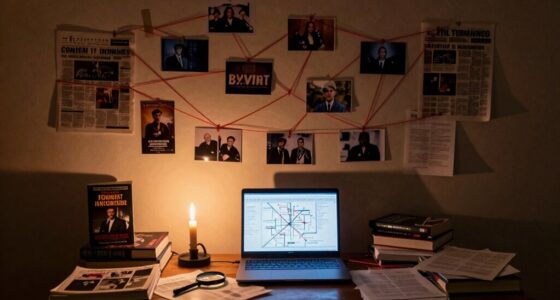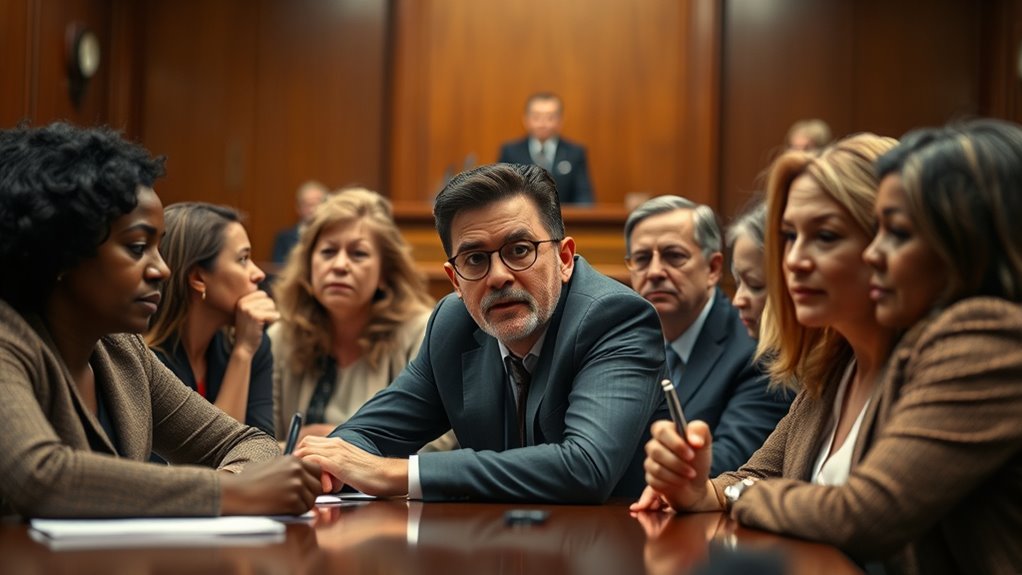

The story model explains how jurors make decisions by creating cohesive narratives from the evidence presented. You actively organize testimonies, physical evidence, and details into a compelling story that supports guilt or innocence. During deliberation, you and fellow jurors exchange ideas, challenge stories, and refine your understanding to find the most convincing explanation. If you explore further, you’ll discover how these stories shape judgments and influence the final verdict in complex cases.
Key Takeaways
- Jurors construct coherent narratives from evidence, prioritizing story coherence over simple fact accumulation.
- The story model emphasizes storytelling to interpret evidence and assess guilt or innocence.
- Deliberation involves exchanging, challenging, and refining stories to fit all evidence convincingly.
- Human cognition seeks understanding through cohesive stories, making narratives central to jury decision-making.
- Recognizing how evidence is organized into stories explains the complexity of reaching a final verdict.
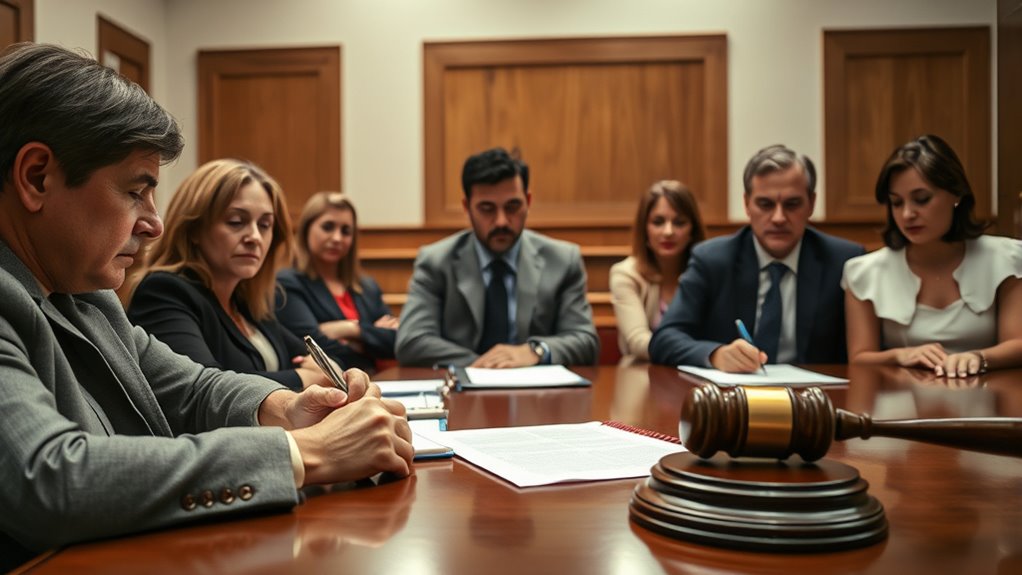
Have you ever wondered how juries decide the fate of a case? It might seem straightforward—listening to evidence, weighing the facts, and then reaching a verdict. But behind the scenes, it’s a complex process rooted in how you evaluate evidence and deliberate as a group. The story model offers a compelling way to understand this process, emphasizing how jurors organize information into a coherent narrative that guides their verdict deliberation. When you serve on a jury, you’re not just passively absorbing facts; you actively interpret and connect pieces of evidence to fit a story that makes sense of the case. This story becomes the backbone of your decision-making, influencing whether you see the defendant as guilty or innocent.
In the story model, evidence evaluation isn’t just about listing facts but about constructing a narrative. You and your fellow jurors sift through the evidence, identifying what’s relevant and how it fits into a larger story. For example, if witness testimony points to intent, you might craft a story that explains the defendant’s motive. If physical evidence supports a timeline, that story becomes more detailed and convincing. This process helps you organize the information, making it easier to see how the pieces fit together or where they might be inconsistent. Your goal is to create a story that aligns with the legal standards for guilt or innocence, shaping your verdict deliberation.
During deliberation, you and your peers exchange stories, challenge each other’s narratives, and refine your understanding of the case. If someone presents a different version, you evaluate whether their story fits the evidence or if it’s based on assumptions or biases. Your judgment depends on how well the stories hold up under scrutiny. This collaborative storytelling process often involves weighing the strength of evidence, considering alternative explanations, and reaching a consensus. The more compelling and consistent the story, the more likely you are to side with a guilty or not guilty verdict.
Ultimately, the story model shows that jury decision-making is a dynamic interplay of evidence evaluation and narrative construction. You’re not just tallying pieces of evidence but weaving them into a meaningful story that guides the verdict deliberation. This approach highlights how human cognition naturally seeks coherence and understanding, making the jury room a place where stories, rather than isolated facts, determine justice. Recognizing the importance of evidence organization can help explain how jurors process complex cases. By understanding this process, you can better appreciate the careful, sometimes complex, journey that leads to a final verdict.

Digital Forensics Trial Graphics: Teaching the Jury through Effective Use of Visuals
As an affiliate, we earn on qualifying purchases.
As an affiliate, we earn on qualifying purchases.
Frequently Asked Questions
How Does the Story Model Compare to Other Jury Decision-Making Theories?
You’ll find that the Story Model emphasizes narrative coherence and emotional appeal more than other theories. Unlike the Legal Model, which focuses on evidence and rules, it highlights how jurors create a compelling story to make decisions. This approach shows that emotional engagement and a clear, logical narrative influence verdicts, making it distinct from models that prioritize factual analysis alone. You see how stories shape jury judgments more deeply here.
What Cognitive Biases Influence Jury Storytelling and Judgments?
You’re influenced by biases like confirmation bias, where you seek evidence supporting your initial impressions, and anchoring effects, which cause you to rely heavily on first information received. These biases shape how you interpret the story presented, often favoring details that confirm your beliefs and giving undue weight to initial facts. Recognizing these biases helps you understand how storytelling can sway judgments and impact your decision-making process.
How Are Jurors’ Personal Experiences Integrated Into the Story Model?
You incorporate your personal memory into the story model by relating the case to your past experiences, which shape your interpretation of the evidence. This integration can lead to experiential bias, where your personal history influences your judgment more than the facts. Your personal memory acts as a lens, coloring how you perceive and connect details, ultimately impacting the narrative you construct and your verdict.
Can the Story Model Predict Jury Verdicts Accurately?
You can’t rely solely on the story model to predict jury verdicts accurately because factors like visual analysis and narrative complexity influence decision-making. Jurors interpret evidence through personal experiences, which shape their understanding of the story. While the model offers insight into how stories are constructed, it doesn’t fully account for individual biases or the complexity of narratives, making precise predictions challenging.
How Do Courtroom Procedures Impact the Story Construction Process?
Courtroom procedures substantially influence how you construct your story during deliberations. Studies show that jurors spend up to 80% of their time evaluating evidence presentation and courtroom dynamics. These procedures shape how evidence is introduced and interpreted, guiding your narrative formation. You naturally focus on the sequence and credibility of evidence, which affects your understanding and ultimately drives your verdict. Efficient procedures help you create a clearer, more coherent story.
jury deliberation storytelling aids
As an affiliate, we earn on qualifying purchases.
As an affiliate, we earn on qualifying purchases.
Conclusion
By understanding the story model, you realize jury decision-making isn’t just about facts—it’s about crafting a compelling narrative. You hold the power to shape the story that tips the scales of justice, making it feel like your words can sway even the heaviest of verdicts. Remember, your influence can be as profound as changing the course of history. So, choose your narrative wisely, because in the courtroom of human minds, your story can be everything.

Inside Jurors' Minds: The Hierarchy of Juror Decision-Making: A Trial Lawyer's Guide to Understanding How Jurors Think (NITA)
Used Book in Good Condition
As an affiliate, we earn on qualifying purchases.
As an affiliate, we earn on qualifying purchases.

Evidence: QuickStudy Laminated Reference Guide (Barcharts Quickstudy: Law)
As an affiliate, we earn on qualifying purchases.
As an affiliate, we earn on qualifying purchases.