Choosing the right streaming microphone for podcasts involves balancing sound quality, ease of use, and budget. The Logitech Blue Yeti stands out as the best overall, offering versatile patterns and simple setup, ideal for most podcasters. For those on a budget, the FIFINE T669 provides solid audio quality without breaking the bank, while the MAONO A04 offers a pro-level sound with great value. The main tradeoffs often involve sacrificing either audio fidelity or convenience, especially when comparing XLR and USB options. Continue reading for a detailed breakdown of each model to find the best fit for your podcasting needs.

Turn your wind-down time into listening time
- Thousands of audiobooks, podcasts and originals
- Listen on your phone, tablet or Echo — also offline
- Cancel anytime
Complete the kit

Key Takeaways
- USB microphones dominate for ease of use, but XLR models often provide higher audio quality with more expandable options.
- The best microphones balance sound clarity with user-friendly features like mute buttons and gain control.
- Budget options can deliver surprisingly good quality but may lack advanced features or durability for long-term use.
- Premium picks tend to include features like multiple polar patterns and professional-grade components, ideal for serious podcasters.
- Compatibility with streaming platforms and ease of setup are key factors that influence real-world usability.




| streaming microphones for podcast | Connectivity | Polar Pattern |
|---|---|---|
| Logitech Blue Yeti USB Microph | USB | — |
| FIFINE AmpliGame A6T USB Gamin | — | Cardioid |
| FIFINE T669 Studio Condenser U | USB | Cardioid |
| ZealSound Podcast Microphone f | USB-C, Lightning adapters included | — |
| FIFINE AmpliGame AM8 USB/XLR D | — | Unidirectional |
| FIFINE AmpliTank K688CT Podcas | USB/XLR | Cardioid |
| MAONO A04 USB Microphone with | — | — |
| TONOR Gaming Microphone Set wi | — | Unidirectional |
| FIFINE AmpliTank K688 Dynamic | — | Unidirectional |
| FIFINE K669B USB Microphone | USB-A | — |
| FIFINE AmpliGame A6V USB Gamin | USB | Cardioid |
| FIFINE AmpliGame AM8T XLR/USB | USB and XLR | Cardioid |
| MAONO PD200W Hybrid Wireless P | Wireless, USB, XLR | — |
More Details on Our Top Picks
Logitech Blue Yeti USB Microphone – Midnight Blue
The Blue Yeti remains a go-to choice for streamers and podcasters who value versatility, thanks to its four pickup patterns and intuitive onboard controls. Unlike the FIFINE AmpliGame A6T, which emphasizes gaming aesthetics, the Yeti offers more professional sound options without needing additional equipment. However, it’s limited to USB connectivity, which might be a drawback for those seeking XLR quality or future scalability. Its plug-and-play setup makes it ideal for beginners, but the built-in stand may not suit all desk setups, requiring an external arm for best positioning. Compared to more specialized models, this microphone provides excellent all-around performance, but at a higher price point and with fewer customization options.
Pros:- Multiple pickup patterns for versatile recording setups
- Plug-and-play compatibility with Mac and PC
- Built-in Blue VO!CE effects enhance audio quality
- Adjustable desktop stand for flexible positioning
Cons:- Requires an external stand or boom arm for optimal positioning
- Limited to USB connection, no XLR option
Best for: Podcasters or streamers who want a flexible, easy-to-use microphone with multiple pickup patterns for different recording scenarios.
Not ideal for: Users seeking future-proof XLR connectivity or professional studio-grade sound without additional investment.
- Pickup Patterns:Cardioid, Omni, Bidirectional, Stereo
- Connectivity:USB
- Color:Midnight Blue
- Software:Blue VO!CE
- Onboard Controls:Headphone volume, pattern selection, mute, mic gain
- Included Accessories:Desktop stand
Our verdict“Ideal for beginners and versatile users who prioritize ease of use and flexible pickup options over professional XLR features.”
FIFINE AmpliGame A6T USB Gaming Microphone Kit
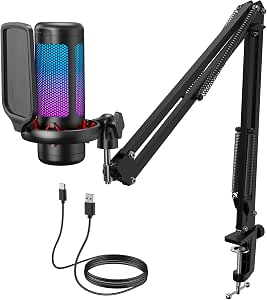
This FIFINE AmpliGame A6T excels in streaming contexts where visual impact matters, thanks to its vivid RGB lighting and included accessories like a boom arm and shock mount. Compared with the Blue Yeti, it emphasizes gaming and aesthetic appeal, making it a strong choice for Twitch streamers or content creators who want a complete setup out of the box. Its plug-and-play design simplifies setup, but the RGB lighting might be unnecessary clutter for users focused solely on audio quality. The included boom arm and pop filter add value, though space for setup and cable management can be a concern. For those who prioritize visual branding and straightforward installation, it offers a compelling package, but it sacrifices some flexibility for style.
Pros:- Easy plug-and-play setup for quick deployment
- Vivid RGB lighting enhances streaming visuals
- Includes adjustable boom arm, shock mount, and pop filter
- High-quality condenser microphone for clear sound
Cons:- RGB lighting may be unnecessary for some users
- Requires space for the boom arm setup
- Limited to USB connection
Best for: Gaming streamers and content creators who want an eye-catching microphone with easy setup and included accessories.
Not ideal for: Audio professionals seeking high-end sound quality or XLR connectivity for studio-grade recordings.
- Compatibility:Windows, Mac OS, PS4, PS5
- Interface:USB-C to USB-A/C
- Cable Length:8.2 ft
- Polar Pattern:Cardioid
- Lighting:RGB gradient
- Included Accessories:Shock mount, pop filter, boom arm, C-clamp
Our verdict“Best suited for gamers and streamers who value aesthetic appeal and convenience over professional-grade audio features.”
FIFINE T669 Studio Condenser USB Microphone for Recording, Podcasting, and Streaming
The FIFINE T669 offers a professional-grade recording experience with its durable build and comprehensive accessories. Its wide frequency response and ability to handle high SPLs make it suitable for vocalists and serious podcasters. Compared to the Blue Yeti, it provides a more robust, studio-like setup with a high-quality boom arm, shock mount, and double pop filter included, making it ideal for dedicated home studios. Its USB connection simplifies setup, but it’s incompatible with gaming consoles like Xbox, and some users may find the setup process for the arm and filters more involved. This model strikes a balance between professional sound quality and ease of use, though it sacrifices the portability and simplicity of more compact options.
Pros:- Complete setup with boom arm, shock mount, and pop filter
- Easy USB plug-and-play connection
- High-quality sound capture with durable construction
- Handles high SPLs for dynamic voices
Cons:- Incompatible with Xbox and some gaming consoles
- Setup can be more involved than simple plug-and-play models
- Limited to PC and laptop use
Best for: Podcasters and voice-over artists seeking a complete, professional setup for home or studio recording without XLR complexity.
Not ideal for: Gamers or casual streamers wanting quick setup and portability, as the kit’s size and setup process are more involved.
- Connectivity:USB
- Frequency Response:Wide
- Max SPL:Handles high SPLs
- Included Accessories:Boom arm, shock mount, double pop filter, USB cable
- Microphone Type:Condenser
- Polar Pattern:Cardioid
Our verdict“Perfect for home studio users who value a professional sound and comprehensive accessories over portability or gaming compatibility.”
The ZealSound K66 stands out for its noise reduction features and broad device compatibility, making it suitable for content creators who record on multiple platforms, from mobile to PC. Its studio-quality audio with real-time noise suppression compares favorably to the Blue Yeti’s simpler approach, but the more complex setup might be daunting for beginners. Its physical controls for gain, monitoring, and echo provide quick adjustments, yet some users may prefer software-based controls for precision. Unlike the FIFINE T669, it emphasizes noise cancellation, making it better suited for noisy environments, but it lacks XLR options, limiting future upgrade paths. This mic offers a blend of convenience and professional features for multi-platform creators.
Pros:- High-quality studio sound with noise reduction
- Wide compatibility including mobile and gaming devices
- Intuitive physical controls for gain, monitoring, and echo
- Real-time zero-latency monitoring
Cons:- Complex setup may overwhelm beginners
- Less precise physical controls than software-based options
- Limited to USB connection only
Best for: Podcasters or streamers needing noise reduction and cross-device flexibility in a single microphone.
Not ideal for: Users seeking a straightforward plug-and-play solution or those wanting XLR connectivity for future upgrades.
- Frequency Response:40Hz–18kHz
- Sampling Rate:46kHz
- Sensitivity:–45dB ±3dB
- Features:Noise Reduction, Monitoring, Echo
- Compatibility:Windows, Mac, PS4, PS5, iPhone, iPad, Android
- Connectivity:USB-C, Lightning adapters included
Our verdict“Best for multi-device content creators who need noise suppression and convenient physical controls but are fine with a USB-only setup.”
FIFINE AmpliGame AM8 USB/XLR Dynamic Microphone for Gaming Streaming, Podcast, Vocal Recording, YouTube
The FIFINE AmpliGame AM8 offers the unique advantage of dual USB and XLR connectivity, making it suitable for a range of users from casual streamers to semi-professional content creators. Its unidirectional pattern helps isolate voice from background noise, unlike the Blue Yeti’s multiple patterns, which can pick up more ambient sound. The RGB lighting adds visual flair, but it’s inactive when using XLR, which may disappoint some users. The built-in mute and monitoring controls are convenient, yet XLR setup requires additional cables and some technical setup, which could be a barrier for beginners. This model strikes a balance between ease of use and professional flexibility, but the need for additional XLR cables and setup complexity limits immediate plug-and-play simplicity.
Pros:- Dual USB and XLR connectivity for versatile use
- RGB lighting with customizable modes
- Mute button and monitoring volume control
- Good for balanced, clear audio in various scenarios
Cons:- RGB lights inactive on XLR connection
- XLR cable not included, additional purchase needed
- Setup complexity for XLR use
Best for: Streamers or podcasters who want the flexibility of USB and XLR, with a focus on vocal clarity and visual branding.
Not ideal for: Users who prefer a simple, portable USB microphone and don’t want to deal with XLR cabling or setup complexity.
- Connectivity Technology:XLR, USB
- Polar Pattern:Unidirectional
- Frequency Response:50Hz-16KHz
- Maximum Frequency:16 KHz
- Additional Features:Headphones Jack, Monitoring Volume, RGB Lights, Mute
- Compatible Devices:Desktop, Laptop, Mixer, Sound Card, Audio Interface
Our verdict“Suitable for content creators seeking flexible connectivity options with emphasis on vocal clarity and style, willing to handle setup complexities.”
FIFINE AmpliTank K688CT Podcast Microphone Kit with Boom Arm, USB/XLR Dynamic Vocal Microphone for Streaming and Recording
This microphone kit stands out for its dual USB and XLR connectivity, offering flexibility that surpasses many single-mode options like the FIFINE K669B, which is limited to USB. The inclusion of a sturdy boom arm and intuitive controls makes it a comprehensive package for streamers and podcasters alike. However, the disabled function keys when using XLR can be frustrating for quick adjustments, and manual setup for input levels is necessary, adding a slight learning curve. Compared to dedicated USB mics, its XLR option makes it more future-proof for expanding into professional audio setups. This pick makes sense for users who want a flexible, upgradeable microphone that can grow with their podcasting needs.
Pros:- Flexible connectivity with both USB and XLR options
- Sturdy boom arm reduces vibrations and noise interference
- Intuitive controls for mute, gain, and monitoring
- High SPL handling for distortion-free recordings
Cons:- Function keys are disabled when using XLR connection
- Controls are limited or require a mixer for some functions
- Adjusting input levels requires manual setup
Best for: Podcasters and streamers seeking a versatile, all-in-one microphone kit with both USB and XLR options
Not ideal for: Beginners who prefer a simple plug-and-play microphone without the need for additional equipment or manual setup
- Connectivity:USB/XLR
- Microphone Type:Dynamic
- Polar Pattern:Cardioid
- Maximum SPL:130dB
- Included Accessories:Boom arm, windscreen, shock mount
- Control Features:Mute button, gain knob, headphone jack
Our verdict“Best suited for podcasters who want flexibility and expandability in their microphone setup.”
MAONO A04 USB Microphone with Pro Sound Chipset, 192kHz/24Bit Condenser Mic Kit for PC, Podcast, Streaming, YouTube
The MAONO A04 excels in delivering professional-quality sound at an accessible price, with high-resolution 192kHz/24Bit audio that rivals more expensive studio mics. Its plug-and-play USB connection makes it very user-friendly, especially for content creators on a budget or those just starting out, unlike the more complex setup of the FIFINE AmpliTank K688CT. The included accessories, like a pop filter and shock mount, add value, though they are somewhat basic compared to premium kits. While it doesn’t support XLR, this simplifies setup for most users. This microphone is ideal for creators who prioritize sound quality and ease of use over advanced connectivity options.
Pros:- High-quality 192kHz/24Bit audio resolution
- Plug-and-play setup with broad device compatibility
- Includes essential accessories for professional sound
- Compact and easy to position on desks
Cons:- Not compatible with Xbox consoles
- Requires external stand or mount for best positioning
- Accessories are basic, not premium quality
Best for: Beginner and intermediate content creators seeking high-resolution audio for streaming and podcasts without complex setup
Not ideal for: Professional studios or users wanting XLR connectivity and advanced audio interface options
- Connectivity Technology:USB, USB Type-C
- Special Features:192kHz/24Bit, Cardioid, Plug and Play
- Compatible Devices:PC, Mac, PS4/5, Mobile
- Microphone Form Factor:Large Diaphragm
- Power Source:USB Microphone
- Frequency Response:16 KHz
Our verdict“Ideal for beginners who want high-resolution audio without complicated setup or additional equipment.”
TONOR Gaming Microphone Set with Boom Arm, RGB Lighting, One-Tap Mute, Volume Control, for Streaming and Content Creation
The TONOR TC310+ is designed for streamers who want both solid sound and visual impact, thanks to its vivid RGB lighting and easy-to-access controls like one-tap mute and volume adjustment. Its high-fidelity condenser offers clear audio, suitable for gaming, streaming, and casual podcasting, though it may not satisfy professionals needing studio-grade quality. The inclusion of a sturdy boom arm and multiple lighting modes make it a favorite for those emphasizing aesthetics, but the bulky design might clutter small desks, and the setup could be overwhelming for users unfamiliar with multiple features. Compared to simpler mics, it offers more customization at the expense of some complexity.
Pros:- Vibrant RGB lighting with adjustable modes
- High-quality sound reproduction with noise cancellation
- Easy one-tap mute and volume controls
- Sturdy boom arm for flexible positioning
Cons:- Requires a USB 2.0/3.0 port for best performance
- Bulky design may not suit small desks
- Complex setup for users unfamiliar with multiple controls
Best for: Streamers and gamers who want a visually striking setup with reliable audio controls
Not ideal for: Podcasters or professionals who prefer minimalistic setups without RGB lighting or extensive features
- Connectivity Technology:USB-A
- Special Features:RGB Lighting, One-tap Mute, Noise Cancellation
- Compatible Devices:Desktop, Laptop, PS4/5
- Polar Pattern:Unidirectional
- Sensitivity:10 dB
- Microphone Form Factor:Shotgun/Gooseneck
Our verdict“Best for streamers who want a visually appealing microphone with straightforward audio controls and lighting effects.”
FIFINE AmpliTank K688 Dynamic Microphone, XLR/USB Podcast Recording PC Mic for Streaming and Studio Use
This microphone emphasizes dual XLR and USB outputs, making it an excellent choice for users who need both convenience and professional upgrade paths, unlike the FIFINE AmpliTank K688CT, which is more kit-focused. Its noise reduction features and durable metal construction provide clear, natural sound suitable for studio and streaming use. However, XLR only functions are limited without a mixer, and the microphone requires close proximity for optimal quality, which might not suit all recording scenarios. It’s a solid pick for those who want a robust, versatile mic that can serve both beginner and advanced setups but are prepared for some manual adjustments.
Pros:- Dual XLR and USB connectivity for maximum versatility
- Built-in mute, gain, and monitoring controls
- Effective noise reduction with accessories
- Robust metal build for durability
Cons:- Requires close proximity for best quality
- XLR cable and stand not included
- All functions only via USB connection
Best for: Podcasters and streamers who want a durable, dual-mode microphone for both casual and semi-professional use
Not ideal for: Those needing a plug-and-play USB mic without the need for additional audio equipment
- Connectivity Technology:USB, XLR
- Special Features:Mute, gain, monitoring controls
- Polar Pattern:Unidirectional
- Frequency Response:50Hz-16KHz
- Impedance:16 ohm
- Power Source:Corded Electric
Our verdict“Best for users who want a durable, multi-mode microphone adaptable for various recording environments.”
FIFINE K669B USB Microphone, Condenser Recording Mic for Vocals, Meetings, Streaming, and YouTube
The FIFINE K669B offers a straightforward, plug-and-play USB setup, making it ideal for users who want clear vocal recordings without fuss. Its metal construction ensures durability, and the cardioid pattern helps reduce background noise, improving clarity during meetings, streaming, or casual podcasting. Unlike more feature-rich microphones like the TONOR TC310+, this model sacrifices advanced controls for simplicity. The limited compatibility to USB-A and some auto volume issues in certain applications can be drawbacks. This mic fits well for those who prioritize ease and reliability over extensive features or aesthetic elements.
Pros:- Simple setup with plug-and-play USB connection
- Durable metal build for longevity
- Clear, crisp sound with noise reduction
- Adjustable volume knob for user control
Cons:- Limited to USB-A connection only
- Not compatible with Xbox or phones
- Auto volume adjustment can interfere with sound levels
Best for: Content creators and online communicators seeking a reliable, easy-to-use USB microphone for everyday use
Not ideal for: Pro streamers or studio professionals requiring advanced controls or XLR connectivity
- Connectivity:USB-A
- Pickup Pattern:Cardioid
- Compatibility:Windows, Mac, PS4/PS5
- Design:Metal
- Power Supply:USB-powered
- Cable Length:5.9 feet
Our verdict“Best for users who want a dependable, no-fuss microphone for streaming and meetings.”
FIFINE AmpliGame A6V USB Gaming Microphone with RGB Lighting, Pop Filter, Shock Mount, and Tripod Stand
The FIFINE AmpliGame A6V stands out for offering high-quality audio with a 192kHz sampling rate, which surpasses many entry-level mics like the FIFINE K669B. Its built-in RGB lighting adds flair to gaming setups, making it perfect for streamers who want style alongside clarity. However, its RGB cannot be customized or turned off, which might be distracting for some. The inclusion of a shock mount and pop filter helps improve sound quality, but the USB-only connection limits flexibility compared to hybrid options like the FIFINE AmpliGame AM8T. This model is ideal for streamers or podcasters who prioritize plug-and-play simplicity and a vibrant setup, but those needing XLR options should look elsewhere.
Pros:- High-resolution 192kHz sampling rate ensures crisp audio
- Vivid RGB lighting enhances gaming aesthetics
- Includes shock mount and pop filter for cleaner sound
- Plug-and-play compatibility with PC, Mac, and consoles
Cons:- RGB lighting cannot be customized or turned off separately
- Limited to USB connection, no XLR option
- Requires stable surface for ideal positioning
Best for: Beginners and casual streamers who want a straightforward, high-quality USB mic with visual flair.
Not ideal for: Advanced users seeking XLR support or customizable RGB lighting for professional-grade setups.
- Sampling Rate:192kHz
- Polar Pattern:Cardioid
- SNR:70dB
- RGB Lighting:Yes, 7 gradient colors
- Connectivity:USB
- Cable Length:6.6 ft
Our verdict“This mic is perfect for gamers and streamers who want excellent sound and eye-catching lighting without complexity.”
FIFINE AmpliGame AM8T XLR/USB Gaming Microphone Set with Boom Arm and RGB Lighting
The FIFINE AmpliGame AM8T offers a flexible connection suite with both USB and XLR, making it suitable for those who want to upgrade from simple USB mics like the FIFINE AmpliGame A6V. Its included boom arm and adjustable stand provide professional positioning, though setup can be more involved due to multiple features. The customizable RGB lighting adds personality to the setup, but the XLR cable isn’t included, which might frustrate those wanting a fully ready-to-go kit. This model suits users who need a step-up in audio quality and flexibility, but beginners should consider simpler options first.
Pros:- Dual USB and XLR connectivity for maximum flexibility
- Includes a sturdy, adjustable boom arm for optimal positioning
- Customizable RGB lighting enhances visual setup
- Mute button and gain control for easy adjustments
Cons:- XLR cable not included, adding to initial cost
- Requires desk clamp for setup, limited to desks up to 2 inches thick
- Setup may be slightly complex for less experienced users
Best for: Intermediate streamers and content creators who want a versatile microphone with professional accessories.
Not ideal for: Complete beginners who prefer plug-and-play solutions or those with limited desk space, as setup can be complex.
- Connectivity:USB and XLR
- Sensitivity:-50dB
- Polar Pattern:Cardioid
- Lighting:RGB customizable
- Included Accessories:Boom arm stand, C-Clamp, USB-C cable
- Microphone Type:Dynamic
Our verdict“This kit is best for streamers seeking a professional-grade microphone with flexible connectivity and adjustable accessories.”
MAONO PD200W Hybrid Wireless Podcast Microphone for PC, Dynamic XLR USB Mic with Desktop Stand, Software, Noise Cancellation, for Vocal Recording, Streaming, Content Creation, Home Studio, Voiceover
The MAONO PD200W excels in offering a hybrid setup with wireless, USB, and XLR options, making it the most adaptable choice for those who want to record in different environments. Its studio-quality sound and noise cancellation outperform simpler USB mics like the FIFINE AmpliGame A6V for professional podcasts and interviews. Battery life of up to 60 hours and a wireless range of 60 meters add convenience for mobile recording. However, it requires the MaonoLink app for full customization, and accessories like camera or lighting are sold separately. This is best suited for tech-savvy users or content creators who need maximum flexibility, but beginners might find the setup and app features overwhelming.
Pros:- Triple connectivity: wireless, USB, and XLR for maximum versatility
- Studio-quality sound with noise cancellation enhances clarity
- Supports dual microphones for interviews or duo recordings
- Long battery life and wide wireless range for mobility
Cons:- Accessories like camera or lighting need to be purchased separately
- Requires app for full customization, adding complexity
- Setup may be challenging for less experienced users
Best for: Professional podcasters and streamers who need versatile connection options and mobility in their recordings.
Not ideal for: Beginners or casual users who prefer simple plug-and-play microphones, as the setup and app learning curve can be steep.
- Connectivity:Wireless, USB, XLR
- Maximum SPL:128dB
- Battery Life:up to 60 hours
- Wireless Range:60 meters
- Noise Cancellation:Yes
- Microphone Type:Dynamic
Our verdict“This microphone is ideal for professionals and mobile creators who want flexible, high-quality sound with maximum mobility.”

How We Picked
These microphones were evaluated based on a combination of sound quality, build durability, ease of setup, versatility, and value for money. We prioritized products that are widely compatible with streaming platforms and offer intuitive controls for live use. Microphones with flexible polar patterns, noise cancellation features, and user-friendly interfaces ranked higher, as they better support different podcasting styles. We also considered feedback from a broad range of content creators to ensure the picks suit both beginners and more experienced streamers. The ranking reflects a balance between professional performance and accessible usability.| streaming microphones for podcast | Connectivity | Polar Pattern |
|---|---|---|
| Logitech Blue Yeti USB Microph | USB | — |
| FIFINE AmpliGame A6T USB Gamin | — | Cardioid |
| FIFINE T669 Studio Condenser U | USB | Cardioid |
| ZealSound Podcast Microphone f | USB-C, Lightning adapters included | — |
| FIFINE AmpliGame AM8 USB/XLR D | — | Unidirectional |
| FIFINE AmpliTank K688CT Podcas | USB/XLR | Cardioid |
| MAONO A04 USB Microphone with | — | — |
| TONOR Gaming Microphone Set wi | — | Unidirectional |
| FIFINE AmpliTank K688 Dynamic | — | Unidirectional |
| FIFINE K669B USB Microphone | USB-A | — |
| FIFINE AmpliGame A6V USB Gamin | USB | Cardioid |
| FIFINE AmpliGame AM8T XLR/USB | USB and XLR | Cardioid |
| MAONO PD200W Hybrid Wireless P | Wireless, USB, XLR | — |
Factors to Consider When Choosing Streaming Microphones For Podcasts
When selecting a streaming microphone for podcasts, it’s important to consider several factors that directly impact your audio quality and workflow. Not all microphones are created equal, and the right choice depends on your specific recording environment, technical needs, and budget. By understanding key considerations, you can avoid common pitfalls like poor connectivity or subpar sound clarity, ensuring that your podcast sounds professional from day one.Microphone Type: USB vs. XLR
USB microphones are popular among streamers for their plug-and-play convenience, requiring no additional equipment. They are ideal for beginners or those who want a simple setup. XLR microphones, on the other hand, typically offer higher audio fidelity and are favored by advanced users willing to invest in audio interfaces and mixers. The choice depends on your long-term goals—USB is sufficient for most casual or beginner podcasts, while XLR suits those aiming for studio-quality sound and expandability.
Sound Quality and Polar Patterns
Clear, natural sound is paramount for engaging podcasts. Microphones with cardioid or hypercardioid patterns focus on capturing your voice while reducing background noise, which is crucial in less controlled environments. Multi-pattern microphones provide flexibility for different recording scenarios, such as interviews or music. Investing in a microphone with good frequency response and noise rejection can significantly elevate your audio quality, but be aware that higher-end models often come with a learning curve in adjusting settings.
Ease of Use and Features
Features like mute buttons, gain controls, and headphone monitoring are more than just conveniences—they help maintain professional sound levels and respond quickly during live recordings. Simpler models may lack these features but are easier to operate, making them suitable for beginners. Conversely, more advanced microphones with customizable controls are better suited for seasoned streamers who want precise audio adjustments without interrupting the flow of their recording.
Build Quality and Durability
Since microphones are often used frequently, durability matters. Metal construction generally indicates better longevity, especially for portable setups or live streaming environments. Cheaper plastic models might save money upfront but could suffer from wear and tear over time. Consider your recording environment—if you’ll be moving your setup often, investing in a sturdy, well-built microphone can avoid frustrating replacements later.
Budget and Long-Term Value
While it’s tempting to opt for the lowest-priced microphone, investing a bit more can improve your audio quality significantly and provide features that save time and effort. Budget models often lack noise cancellation and advanced controls, which can lead to editing headaches or less professional sound. Conversely, premium microphones tend to last longer and deliver consistently better results, making them worthwhile for serious podcasters or those aiming to grow their audience.
Frequently Asked Questions
Is a USB microphone sufficient for professional podcasting?
For most beginner and intermediate podcasters, a high-quality USB microphone is enough to produce professional-sounding audio. They are easy to set up and don’t require additional equipment, making them ideal for home studios or quick streaming setups. However, if you’re aiming for studio-grade sound or plan to expand your audio gear, investing in an XLR microphone paired with an audio interface can provide greater control and higher fidelity. For many, a good USB mic strikes the right balance between convenience and quality.
What features should I prioritize for live streaming podcasts?
Features like a mute button, gain control, and headphone monitoring are essential for smooth live sessions. These controls allow you to adjust audio levels on the fly and respond quickly to issues without disrupting the flow of your stream. Noise cancellation and cardioid polar patterns also help isolate your voice from background noise, improving clarity. Prioritizing these features ensures a more professional and interruption-free streaming experience.
Can I use a gaming microphone for podcasting?
Many gaming microphones are versatile enough for podcasting, especially those with cardioid patterns and good noise rejection. They often come with features like RGB lighting and sturdy builds, which appeal to streamers. However, some gaming mics are optimized for voice chat and may lack the nuanced audio quality necessary for polished podcasts. If you choose a gaming mic, look for models with good frequency response and noise filtering to ensure your voice sounds clear and natural.
How does the polar pattern affect my microphone choice?
The polar pattern determines how much sound the microphone picks up from different directions. Cardioid patterns are most common for podcasts because they focus on your voice and reduce ambient noise. Omnidirectional or multi-pattern mics can capture sound from multiple directions, useful in interview settings or group recordings. Choosing the right pattern depends on your recording environment and whether background noise or multiple speakers are involved. Understanding this helps you select a mic that minimizes post-production editing.
Is it worth paying more for a premium microphone?
Investing in a premium microphone can significantly improve your audio clarity, noise rejection, and durability. Higher-end models often feature better components, more versatile polar patterns, and professional-grade sound quality, which can make a noticeable difference in your podcast’s production value. If you plan to stream regularly or want to grow your audience, a premium mic can be a worthwhile investment that pays off in consistent, high-quality audio. However, for casual or hobbyist podcasters, mid-range options often provide excellent value without the higher cost.
Conclusion
For those starting out or on a tight budget, the FIFINE T669 offers reliable sound at a low price. If you want a versatile all-rounder with simple setup, the Blue Yeti remains a favorite. Content creators seeking professional studio-quality sound should consider premium options like the MAONO A04 or MAONO PD200W. Beginners or casual streamers will find plug-and-play models sufficient, while more advanced podcasters should look at XLR options with additional audio gear for maximum control. Ultimately, your choice depends on your current needs and future goals, but this roundup ensures you’ll find a microphone that elevates your podcast’s sound in 2026.