
Surveillance today often hides its true purpose behind claims of care and safety, but it primarily serves to control and influence your behavior. Authorities use constant monitoring to shift power dynamics, reducing your privacy and autonomy without your clear awareness. This pervasive oversight can lead you to self-censor and accept restrictions as normal. As you explore further, you’ll discover how surveillance molds perceptions and molds society in subtle yet significant ways.
Key Takeaways
- Surveillance shifts from protecting to controlling, subtly reinforcing power structures under the guise of safety.
- Authorities expand monitoring to influence behavior and maintain authority, often masking true motives.
- Privacy erosion occurs as surveillance becomes pervasive, reducing individual autonomy and fostering self-censorship.
- Daily environments are infiltrated by surveillance, transforming trust-based spaces into scrutinized zones.
- Recognizing the motives behind surveillance helps challenge its use as a tool for control rather than genuine care.
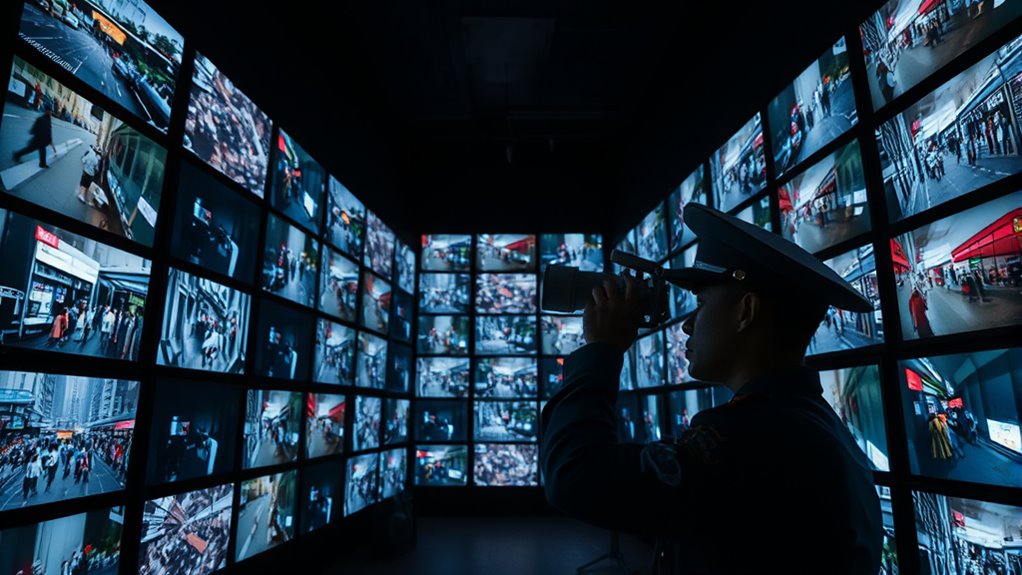
Have you ever wondered how surveillance transforms from a tool of security into a means of control? It’s a question that strikes at the heart of modern society, where constant monitoring subtly shifts the balance of power. When surveillance is framed as a way to keep you safe, it often masks a deeper intent: to erode your privacy and reinforce those in authority. As cameras, data collection, and digital tracking become more pervasive, your personal boundaries are gradually chipped away, replaced by an environment where every move is observed and recorded. This erosion of privacy isn’t accidental; it’s a calculated consequence of expanding surveillance systems designed to serve those in power. They use the guise of protection to justify intrusive measures, making it seem necessary for your own good. But in reality, these practices deepen existing power dynamics, giving authorities greater control over individuals’ lives. You might feel reassured by the notion of safety, yet you’re also unknowingly surrendering your autonomy. Surveillance becomes a tool that consolidates authority, making dissent more difficult and compliance more ingrained. When authorities monitor citizens under the pretense of care, the lines between protection and manipulation blur. They can justify intrusive actions by claiming they’re acting in your best interest, but this often leads to a chilling effect—where you self-censor, aware that every word, move, or online search could be scrutinized. The power dynamics at play are subtle yet profound; those who control the surveillance infrastructure wield disproportionate influence. They determine what is acceptable, what is normal, and what isn’t. Your consent becomes secondary to the perceived necessity of security measures, which are often implemented without transparent oversight. This imbalance tilts the relationship between the governed and the governing, turning what should be a partnership into a monitored obedience. As surveillance expands, you might notice how it infiltrates everyday scenarios—from workplace monitoring to social media oversight—further tightening the grip of those in authority. Instead of a mutual trust, you’re left steering a landscape where your actions are constantly scrutinized, and your privacy becomes a commodity traded for supposed safety. Recognizing the shift from surveillance as a protective tool to a means of control is vital. It allows you to question the motives behind these systems and consider how power dynamics influence your freedom. In this environment, vigilance becomes essential—so you can resist the subtle encroachments on your privacy and challenge the narrative that surveillance is always about care. Additionally, understanding the role of wall organization systems can reveal how functional and aesthetic solutions are used to subtly influence your perception of space and control.
Frequently Asked Questions
How Do Surveillance Practices Vary Across Different Cultures?
You’ll notice that surveillance practices vary widely across cultures, shaped by different cultural norms and privacy expectations. In some societies, close monitoring is seen as caring and protective, while in others, it’s viewed as intrusive and unacceptable. You might find that communities with strong emphasis on collective well-being accept more surveillance, whereas those valuing individual privacy resist it. Understanding these cultural differences helps you appreciate why surveillance is perceived and implemented differently worldwide.
What Are the Psychological Impacts of Constant Monitoring?
You might feel anxious, stressed, or paranoid due to constant monitoring, which can erode your privacy and lead to a sense of loss of control. Over time, this ongoing surveillance can negatively impact your mental health, causing feelings of helplessness or distrust. You could also become more self-conscious, constantly worried about being watched, which further heightens your stress and diminishes your overall well-being.
Can Surveillance Be Ethically Justified in Any Context?
You might argue that surveillance can be ethically justified if it addresses privacy concerns and guarantees safety. However, you must consider consent challenges, as people often aren’t fully aware of or agree to monitoring. If transparency is maintained and individuals voluntarily consent, surveillance could be justified in specific contexts like healthcare or security. Still, you should carefully balance benefits against potential infringements on personal privacy and autonomy.
How Does Surveillance Technology Evolve Over Time?
You watch as surveillance technology evolves rapidly, driven by relentless technological innovation. Each breakthrough pushes boundaries, increasing privacy erosion without warning. You wonder how far it will go—will it serve genuine safety or deepen control? As advancements accelerate, your privacy feels more fragile. Staying informed and vigilant becomes essential, because with every new development, the line between protection and intrusion blurs, leaving you questioning what’s truly at stake.
What Are the Legal Limits of Surveillance for Care Purposes?
You need to understand that legal boundaries for care surveillance limit how much monitoring is allowed. Privacy concerns are central, so laws often require consent and restrict data use. You must guarantee that surveillance is proportionate and necessary, balancing care benefits with individual rights. Violating these legal limits can lead to fines or lawsuits, so always stay informed about regulations to protect privacy while providing effective care.
Conclusion
You might not realize it, but nearly 80% of people feel uncomfortable with how much surveillance is used in daily life. This shows that what’s presented as “care” often masks control, subtly shaping your choices and behaviors. By accepting these monitoring practices, you risk losing privacy and autonomy. Remember, vigilance is key—question what’s being monitored and why, so you don’t become a passive participant in your own surveillance-driven control.