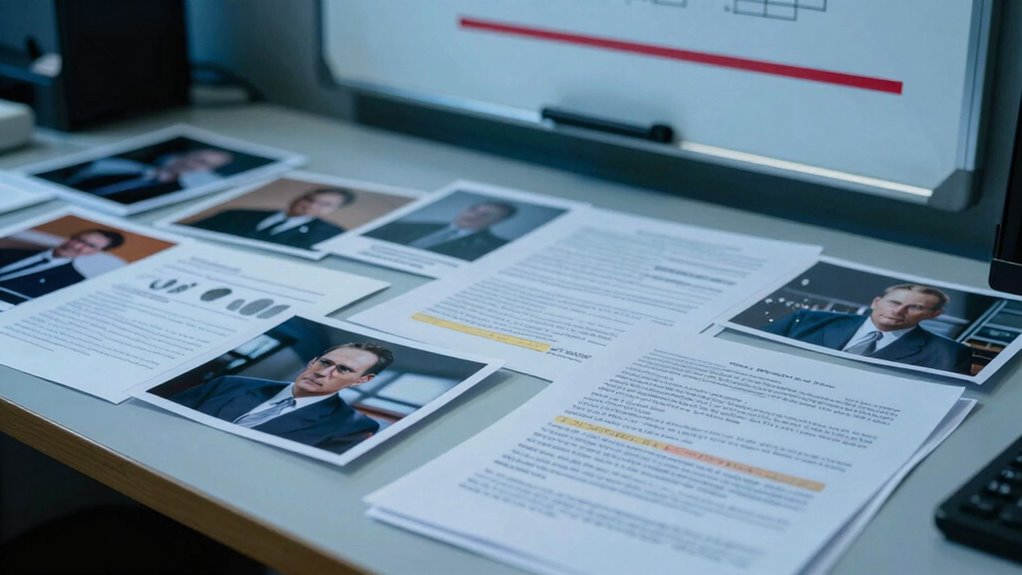

When you face investigative pressure, you might focus too quickly on certain evidence or suspects, which limits your perspective. This can lead to confirmation bias, where you only see what supports your initial ideas. Rushing to conclusions may cause you to overlook alternative theories or critical clues. Staying open-minded and questioning assumptions helps avoid this trap. If you continue, you’ll discover effective strategies to maintain objectivity and consider all possibilities thoroughly.
Key Takeaways
- Increased pressure can cause investigators to focus prematurely on certain evidence, limiting exploration of alternative leads.
- It may reinforce initial assumptions, leading to confirmation bias and overlooking critical evidence or suspects.
- Forensic techniques can be over-interpreted or misinterpreted, especially when samples are contaminated or incomplete.
- Under pressure, investigators might favor evidence that fits a narrative, risking biased conclusions.
- Rushing to close cases can reduce thoroughness, ignore plausible scenarios, and increase the risk of false accusations.

When investigators intensify their efforts, they often find that their options quickly start to shrink, forcing them to focus more narrowly on key evidence and leads. This narrowing isn’t always beneficial, as it can cause you to overlook alternative theories or suspects. As pressure mounts to solve a case, you might rely heavily on certain forensic techniques, which, while powerful, can sometimes reinforce initial assumptions rather than challenge them. It’s easy to become tunnel-visioned, especially when the urgency to close the case grows, but this can lead to confirmation bias, where you unconsciously favor evidence that supports your hypothesis and dismiss what contradicts it.
To avoid this trap, bias mitigation becomes essential. You need to actively question your assumptions and ensure that your focus remains balanced. Forensic techniques, such as DNA analysis, fingerprinting, or digital forensics, are invaluable tools, but they can also be misinterpreted if you’re not careful. For example, partial or contaminated samples might point you toward a suspect prematurely, or you might give too much weight to evidence that fits your narrative while neglecting other possibilities. The goal is to scrutinize each piece of evidence objectively, recognizing the potential for bias to influence your interpretation.
Question your assumptions and scrutinize evidence objectively to prevent bias from influencing your forensic interpretations.
When the pressure to produce results is high, it’s tempting to cherry-pick forensic findings that seem to support your leading theory. To counteract this, you must implement systematic procedures for bias mitigation, such as blind analysis or peer review, where colleagues independently evaluate the evidence without knowing the case hypothesis. This approach helps ensure that your focus remains on the facts rather than assumptions or expectations. Being aware of cognitive biases and actively working to counteract them can significantly enhance the objectivity of your investigation.
Furthermore, maintaining awareness of cognitive biases helps you stay vigilant. You should continually ask yourself whether you’re considering all plausible scenarios or just the ones that seem most likely. This self-awareness can prevent you from prematurely narrowing the scope of your investigation. Remember, the more you restrict your focus early on, the greater the risk of missing critical evidence or falsely implicating innocent parties. Incorporating objective analysis methods can also support maintaining an open-minded approach and reduce the influence of personal biases.
In the end, balancing the use of forensic techniques with bias mitigation strategies ensures your investigation remains thorough and objective. Recognizing the dangers of rushing to conclusions under pressure allows you to keep an open mind, which is vital for uncovering the truth. The key lies in resisting the temptation to narrow your options too soon, even when the pressure to close the case is intense. Being aware of investigative pressure and its effects can help you maintain a comprehensive approach and avoid prematurely dismissing alternative avenues.

Forensic Chemistry of Hair Analysis Experiment Kit – Explore How Forensic Scientists Use Hair to Help Solve Crimes – Science at Home Series – Innovating Science
- Educational Forensic Chemistry Kit: Learn forensic hair analysis techniques
- Hands-On Investigative Exercises: Build analytical and investigative skills
- Includes Hair Samples and Tools: Deer, cat, and human hair samples with accessories
As an affiliate, we earn on qualifying purchases.
As an affiliate, we earn on qualifying purchases.
Frequently Asked Questions
How Can Investigators Balance Pressure Without Limiting Options?
You can balance pressure by maintaining bias awareness, ensuring you don’t jump to conclusions prematurely. Be strategic with resource allocation, focusing efforts on multiple leads rather than fixating on one theory. Regularly review your progress to stay flexible, and encourage team collaboration for diverse perspectives. This approach helps you keep options open, prevents tunnel vision, and allows thorough investigation without compromising the investigation’s integrity under pressure.
What Are Signs of Investigative Pressure Leading to Tunnel Vision?
You might notice signs of investigative pressure leading to tunnel vision when bias awareness diminishes, and you cling to initial hypotheses despite conflicting evidence. Cognitive flexibility decreases, making you dismiss alternative leads or overlook new angles. If your focus narrows prematurely, it’s a clear sign that pressure is clouding judgment. To avoid this, stay aware of biases, challenge assumptions regularly, and remain open to different possibilities, ensuring a balanced and thorough investigation.
How Does Pressure Impact Objectivity in Investigations?
Imagine a tightrope walker balancing carefully—pressure can tilt your perspective, cloud your objectivity. You might develop biases, losing sight of alternative leads. To stay steady, you need bias awareness, recognizing your own assumptions, and emotional resilience to handle stress without rushing to conclusions. This keeps your investigation open-minded, preventing tunnel vision. By managing pressure, you guarantee your judgment remains balanced, thorough, and not swayed by immediate stress or preconceived notions.
Can Pressure Cause Investigators to Overlook Alternative Suspects?
Yes, pressure can lead you to overlook alternative suspects. When you’re under stress, bias awareness might falter, making you focus on a suspect who fits a particular profile or matches initial assumptions. This narrow focus can cause you to miss other viable leads. To avoid this, you should consciously question your assumptions, stay open-minded, and consider all possibilities, regardless of how compelling the initial suspect seems.
What Methods Prevent Premature Narrowing of Possibilities?
To prevent premature narrowing, you should practice bias awareness and creative questioning. For example, imagine a case where initial assumptions lead investigators to focus solely on a suspect, missing other leads. Regularly challenging your assumptions and asking open-ended questions helps you explore all possibilities. This approach keeps the investigation flexible, reducing the risk of tunnel vision and ensuring you consider alternative suspects or scenarios thoroughly.

Leelosp Basic Latent Fingerprint Kit Bichromatic Fingerprint Powder Finger Print Forensic Science Kit
- Complete Educational Fingerprint Kit: Includes supplies for 25+ uses with storage case
- Fiberglass Fingerprint Brush: Softens with use, holds more powder, reusable tube
- Bichromatic Fingerprint Powder: Silver and black for versatile surface contrast
As an affiliate, we earn on qualifying purchases.
As an affiliate, we earn on qualifying purchases.
Conclusion
If you let investigative pressure push you to conclusions too quickly, you’ll risk narrowing possibilities like a black hole devours light. Remember, rushing hampers your ability to uncover essential clues and can lead you astray in the labyrinth of truth. Take your time, stay open-minded, and resist the urge to jump to the first answer. In the end, patience and persistence are your greatest allies—without them, you’ll miss the forest for the trees.

Caine Computer Forensics Bootable Linux USB for PC
- USB Compatibility: Supports USB-A and USB-C ports
- Customizable USB: Add, replace, or upgrade ISO apps
- Forensics Environment: Includes CAINE for digital investigations
As an affiliate, we earn on qualifying purchases.
As an affiliate, we earn on qualifying purchases.

AccuMeth0.5,4-Part Methamphetamine Residue Detection Test Kit for Homes | 0.5 µg/100cm2 Legal Standard (Pack of 1)
- Includes Complete Testing Kit: Gloves, templates, wipes, buffer, and instructions
- Tests Four Areas Simultaneously: Provides an average result for accuracy
- Detects Meth Residue at 0.5 µg/100cm2: Meets legal safety standards
As an affiliate, we earn on qualifying purchases.
As an affiliate, we earn on qualifying purchases.